

https://youtu.be/XZgUg0faFGI?is=T2eGGVTAIYWg62zf
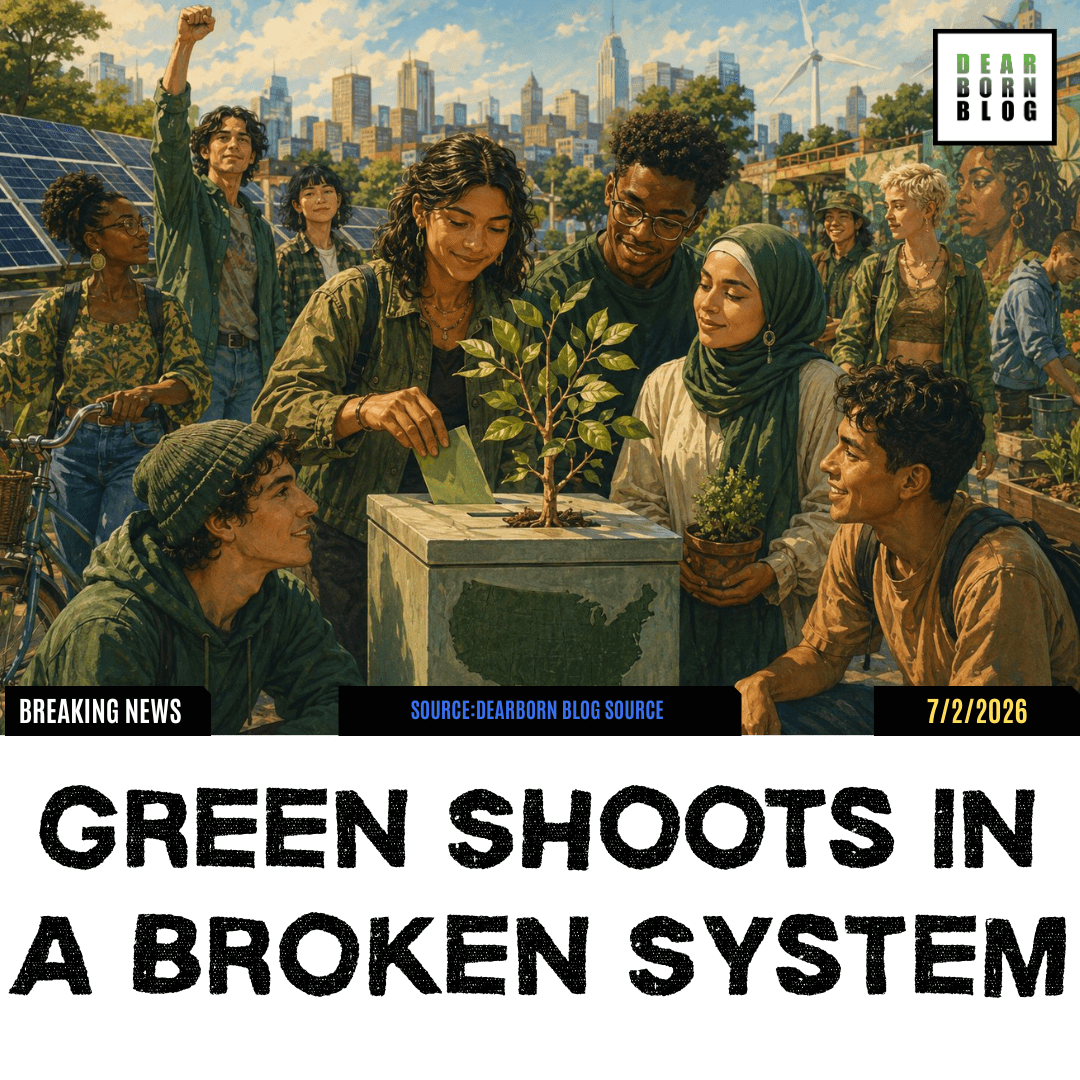
Excerpt: The 2026 Green Party candidate data does not show a party that has arrived at power. It shows something more important: a party building roots where the future is already looking for political shelter. With 103 candidates across the country, growing youth frustration with the two-party system, and Gen Z values increasingly aligned with climate justice, peace, democracy, affordability, and human rights, the Green Party may be closer to its moment than Washington wants to admit.
American politics has a bad habit of confusing power with permanence. Because Democrats and Republicans dominate the ballot, the money, the debates, the media cycle, and most elected offices, many people assume they also dominate the future. But history is not kind to political machines that mistake control for legitimacy. The attached 2026 Green Party candidate data offers a different picture: not a revolution completed, not a wave fully formed, but unmistakable signs of growth in the soil.
As of June 30, 2026, the Green Party candidate list shows 103 candidates running in 104 contests across the United States, including 12 candidates for governor, 34 for the U.S. House of Representatives, 5 for the U.S. Senate, 15 for state lower-house seats, 18 for other statewide offices, and 12 for local offices.[1] That is not a small footnote. That is a national organizing footprint. In a political system designed to crush third parties before they even reach the starting line, 103 candidates is not weakness. It is evidence of persistence.
The Green Party is not growing because American politics is healthy. It is growing because millions of people can see that American politics is sick.
The data also shows active Green chapters or affiliates running candidates in Arizona, California, Colorado, Florida, Hawaii, Illinois, Indiana, Maine, Maryland, Massachusetts, Michigan, Minnesota, New Jersey, North Carolina, Oregon, Pennsylvania, South Carolina, Texas, Washington, Washington D.C., West Virginia, and Wisconsin.[1] That matters because parties do not grow only from presidential campaigns. They grow from local organizers, ballot fights, candidate recruitment, school board races, city councils, statehouse campaigns, petition drives, and people willing to lose today so the next generation has a real choice tomorrow.
Michigan deserves special attention. The data lists 11 Green Party candidates in Michigan, including Douglas Philip Marsh for U.S. Senate, multiple U.S. House candidates, Eric Borregard for Secretary of State, and Jett Newton for State Representative in the 38th House District.[1] For Dearborn, this should not be treated as political trivia. Michigan is one of the most politically watched states in America. It is also home to communities that understand war, immigration, labor, environmental injustice, surveillance, Palestine, and the price of being ignored by both major parties. If Green politics has a serious future, Michigan is not a side street. It is one of the main roads.
2026 Green Snapshot
103 candidates. 104 offices contested. 34 U.S. House races. 12 governor races. 11 Michigan candidates. 11 Texas candidates. 18 California Green/Peace and Freedom left-unity candidates. That is not yet a governing party — but it is a serious organizing map.[1]
The most optimistic part of this data is not just the number of candidates. It is the range of offices. A party that only runs symbolic presidential campaigns is making a statement. A party that contests governor, Congress, state legislatures, secretary of state, city council, county council, school board, controller, treasurer, and local commissions is building infrastructure. The Green Party’s national candidate page confirms that the party is actively listing 2026 candidates and directing voters toward ballot-qualified campaigns.[2] The difference matters. Protest is a moment. Infrastructure is a future.
To be honest, the Green Party still faces serious obstacles. The same data shows many active Green chapters with no candidates this cycle, including Alabama, Alaska, Arkansas, Georgia, Iowa, Louisiana, Mississippi, Missouri, Montana, Nebraska, Nevada, New Mexico, New York, Ohio, Oklahoma, Tennessee, Utah, and Virginia.[1] Connecticut, Delaware, and Kansas are listed as pending or unfinalized, while several states are inactive, dissolved, disaffiliated, or lacking a formal state party.[1] That is the honest picture. The Green Party is growing, but unevenly. It is alive, but not equally organized everywhere. It has energy, but still lacks the machinery that the two major parties inherited, hoarded, and legally protected.
Still, movements do not become real only when CNN notices them. They become real when their ideas begin showing up everywhere — even inside other parties. Reuters reported on July 2, 2026, that progressive candidates have been winning Democratic primaries in multiple states while campaigning on policies such as taxing the rich, cutting military spending, opposing U.S. funding for Israel, expanding public programs, universal healthcare, and redirecting money away from war and enforcement toward domestic needs.[9] Sound familiar? The establishment may call these ideas “radical,” but many of them have been part of Green politics for decades. Sometimes a party wins not only by winning seats, but by forcing the moral vocabulary of the country to move.
This is especially visible with Gen Z. The young generation is not automatically “Green Party.” No serious analysis should pretend that. But Gen Z is increasingly green in values: climate-conscious, skeptical of endless war, angry about housing costs, distrustful of corporate politics, more open to independent politics, and less willing to clap like trained seals every time one of the two parties says, “At least we are not the other guy.” The Associated Press, summarizing Gallup polling, reported that 45% of U.S. adults now identify as independents and that more than half of Gen Z and Millennials identify as political independents, with 56% of Gen Z adults calling themselves independent.[8] That is not a small generational mood swing. That is a warning siren aimed directly at the duopoly.
Gen Z is not politically apathetic. It is politically under-homed.
That distinction is everything. Young people are not simply lazy, spoiled, or addicted to screens, as the usual pundit class likes to claim between commercials for defense contractors and prescription drugs. The problem is deeper. Many young Americans do not see themselves reflected in the available political choices. CIRCLE’s post-2024 youth research found that less than one in four young people felt they belonged to a group that expresses itself politically, and only 13% of young nonvoters felt that sense of political belonging.[6] That is an invitation for a party like the Greens — but only if the party can organize with seriousness, humility, cultural fluency, and local trust.
The same CIRCLE research found that youth priorities are not one-dimensional. The cost of living and inflation were the top issues, but young people also named healthcare, abortion, climate, and immigration as important concerns.[6] This is where Green politics has a strategic opening. The Green Party should never allow climate to be framed as a boutique issue for people who already have comfortable lives. Climate is housing. Climate is water. Climate is asthma in poor neighborhoods. Climate is utility bills. Climate is food prices. Climate is insurance costs. Climate is migration. Climate is war. Climate is whether children in Dearborn, Detroit, Gaza, Beirut, Flint, Phoenix, and Los Angeles can breathe, drink, eat, and live.
Yale’s 2026 climate-election research strengthens this argument. The Yale Program on Climate Change Communication reported that most registered voters prefer candidates who support action on global warming, including 59% overall, 95% of liberal Democrats, 82% of moderate/conservative Democrats, and even 42% of liberal/moderate Republicans.[7] Yale also found that majorities in nearly every state think Congress should do more to address global warming, while 60% nationally say developing clean energy should be a high or very high priority.[7] This should encourage Greens. The public is not as hostile to climate action as fossil-fuel politics makes it appear. The people are ahead of the politicians. Again. Shocking — like finding gambling in a casino.
The Harvard Youth Poll adds another layer. Its Spring 2026 survey of 18- to 29-year-olds found young Americans under intense economic pressure, with inflation and housing defining what many see as a true crisis, while trust in government remains low.[4] Harvard reported that half of young Americans say people like them have no real say in government and that trust in the federal government has fallen to 15%.[4] That is not just cynicism. That is democratic alienation. And democratic alienation can go in dangerous directions if it is not given a constructive outlet. It can turn into apathy, authoritarianism, conspiracy, nihilism, or despair. But it can also turn into local organizing, mutual aid, independent politics, and a new civic imagination.
This is where the Green Party has to be optimistic without becoming delusional. The numbers show growth, but not a shortcut. In 2024, CIRCLE estimated youth voter turnout at 47%, down from the historically high turnout of 2020, and only 1% of young voters backed a third-party or independent presidential candidate in that election.[5] That is the cold water. The young generation may be independent in identity and green in values, but that does not automatically translate into Green Party votes. Organizing is the bridge. Ballot access is the bridge. Credible local candidates are the bridge. Showing up in neighborhoods between election cycles is the bridge. Nobody builds a party by posting a leaf emoji and calling it a revolution.
The Green Party’s own platform gives it a powerful foundation. The party organizes itself around democracy, political reform, ballot access, proportional representation, ranked-choice voting, public campaign financing, foreign policy, human rights, and the Palestinian-Israeli conflict as part of its official platform structure.[3] These are not fringe issues in Dearborn. They are kitchen-table issues. In our city, foreign policy is not foreign. It arrives in our families, our mosques, our churches, our grief, our remittances, our trauma, and our organizing. Palestine is not an abstract “issue.” It is a test of whether American politics can still recognize Palestinian life as human life.
That is why Green Party growth matters to Dearborn. The two-party system has repeatedly asked Arab, Muslim, immigrant, Black, brown, working-class, anti-war, and climate-conscious voters to accept crumbs in exchange for silence. It has told us to fear the worse option so deeply that we stop demanding the better one. It has treated our votes as emergency equipment: break glass every November, then ignore until the next fire. Dearborn knows this routine. We have seen politicians discover our community during campaign season and forget our pain once the cameras leave.
A democracy that only offers two doors, both guarded by corporate money, is not a democracy at full strength. It is a hallway with better branding.
The attached 2026 candidate data suggests that Greens are trying to build more doors. California’s Green Party and Peace and Freedom left-unity slate includes 18 candidates, including Kenneth Mejia, who won reelection outright as Los Angeles City Controller with 63% of the vote.[1] That example matters because it shows a realistic path: local credibility, transparent governance, city-level competence, and a campaign rooted in public service rather than abstract purity. Greens do not need to begin by pretending they will instantly capture the White House. They can begin by winning offices where budgets are audited, water systems are protected, rents are debated, police contracts are reviewed, and public money can be made visible.
Texas also stands out with 11 Green candidates, including candidates for lieutenant governor, U.S. House districts, state legislature, agriculture commissioner, and state comptroller.[1] Arizona lists 12 candidates, though with the important caveat that some are endorsed, some not endorsed, and some actively opposed by the Arizona Green Party.[1] That caveat should not be ignored. Growth brings complications. A party that expands must protect its standards, vet candidates seriously, and avoid becoming a ballot label for opportunists. Optimism without internal discipline becomes chaos wearing campaign buttons.
But even those complications are signs of life. Dead parties do not have messy candidate lists. Dead parties do not struggle over endorsement standards. Dead parties do not fight ballot-access battles in Kansas, coordinate left-unity slates in California, run congressional candidates in Michigan and Texas, or contest local offices in Washington, D.C., South Carolina, West Virginia, and Wisconsin.[1] Mess is not always failure. Sometimes mess means a movement is moving.
The Gen Z opportunity is not that young voters are waiting to be told what to think. They are not. The opportunity is that many already believe things the Green Party has been saying for years: the planet is not disposable, healthcare should not bankrupt people, housing should not be a luxury product, public money should serve public needs, endless war is immoral and unaffordable, democracy should include more than two corporate-funded choices, and human rights should not stop at the borders of U.S. allies.
For the Green Party to grow with this generation, it must speak less like a minor party asking for permission and more like a civic home ready to do the unglamorous work. That means campus chapters, union solidarity, immigrant-community outreach, Arabic and Spanish language materials, candidate training, local policy clinics, youth advisory councils, digital organizing, voter-registration education, and year-round presence. It also means running candidates who can explain potholes and Palestine, climate and grocery prices, ranked-choice voting and rent, Gaza and Great Lakes water, all in the same breath — because real life does not separate these issues into neat little cable-news boxes.
Dearborn should watch this Green growth carefully and hopefully. Our community has always understood the limits of symbolic inclusion. A photo-op is not power. A proclamation is not justice. A campaign promise is not policy. If the Green Party wants to matter here, it must earn trust here. It must stand clearly for Palestine, against racism and Islamophobia, for working families, for clean air and water, for immigrant dignity, for small businesses, for labor, for students, for public schools, and for democracy that does not treat ballot access like a private club.
The attached data is not a victory lap. It is a seed report. Some seeds will not grow. Some chapters need rebuilding. Some races will be long shots. Some candidates will lose badly. That is politics. The question is not whether every Green candidate wins in 2026. The question is whether the Green Party is becoming a credible container for the values millions of Americans, especially younger Americans, already hold. The answer, increasingly, is yes — cautiously, unevenly, but unmistakably yes.
And from Dearborn’s perspective, that is worth taking seriously. Because when a generation that fears climate collapse, rejects endless war, distrusts corporate politics, and refuses to forget Palestine starts looking for a political home, the future will not belong automatically to the parties that broke the house. It will belong to those willing to rebuild it.
Sources and Citations
[1] 2026 Green Party Candidates, attached PDF, updated as of June 30, 2026.
[2] Green Party of the United States, “2026 Candidates,” official candidate listing page.
[3] Green Party of the United States, official platform, including democracy, electoral reform, foreign policy, human rights, and Palestinian-Israeli conflict sections.
[4] Harvard Kennedy School Institute of Politics, 52nd Harvard Youth Poll, Spring 2026.
[5] Tufts University CIRCLE, “The Youth Vote in 2024.”
[6] Tufts University CIRCLE, “Young People and the 2024 Election: Struggling, Disconnected, and Dissatisfied,” January 15, 2025.
[7] Yale Program on Climate Change Communication, “YPCCC Insights on Climate Change and the 2026 U.S. Primaries,” April 2, 2026.
[8] Associated Press, reporting on Gallup polling about rising independent identification among Americans, especially Gen Z and Millennials.
[9] Reuters, “Progressive surge complicates Democrats’ midterms focus on prices,” July 2, 2026.
Disclaimer
This article is an opinion and analysis piece based on publicly available information, polling, reporting, and the attached 2026 Green Party candidate data. It is intended for commentary, civic discussion, and educational purposes. Dearborn Blog does not claim that every listed candidate will remain on the ballot, win office, or represent every position described here. Readers should verify local ballot status, campaign platforms, and election rules through official election authorities and candidate websites before making political decisions.

 Dearborn Blog