

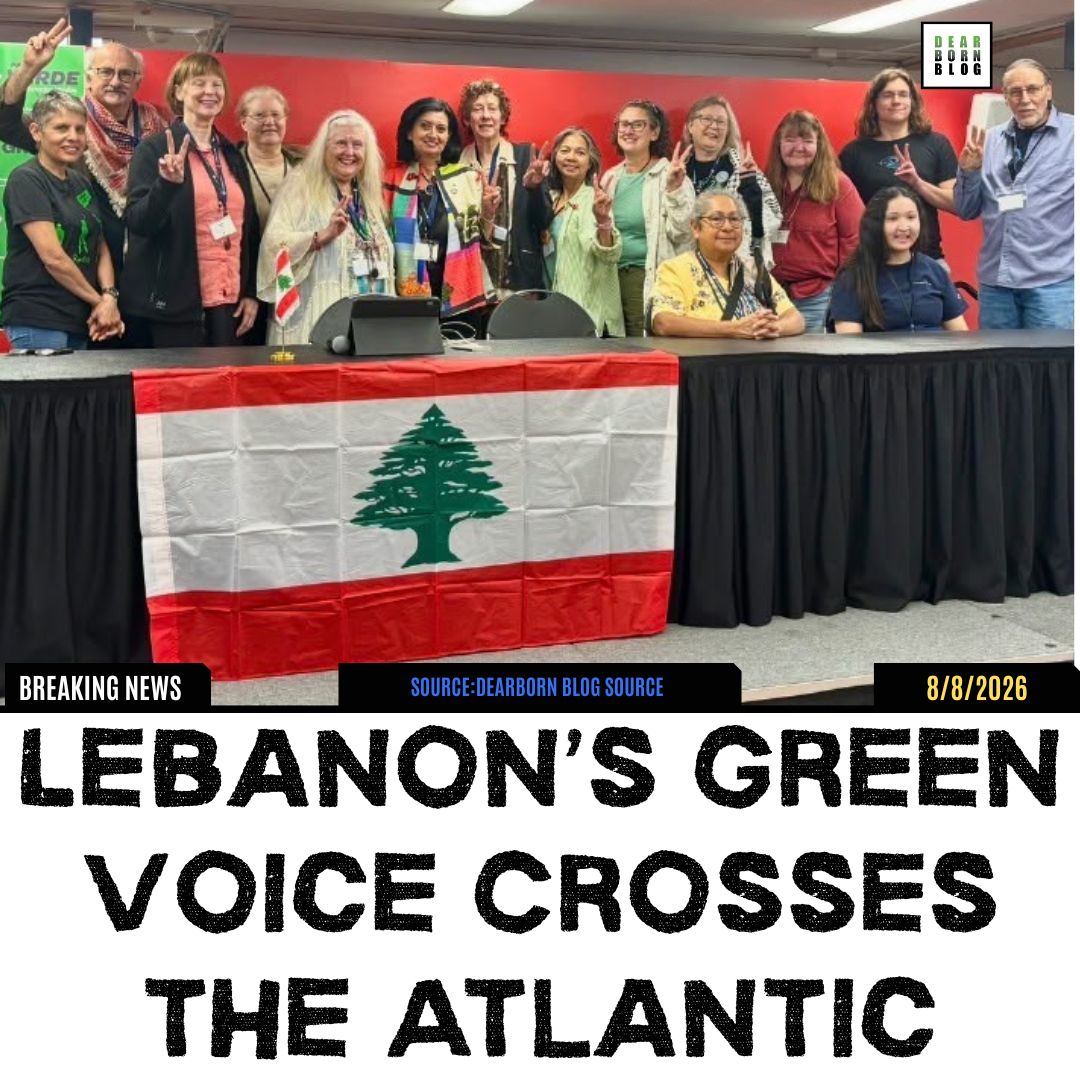
Excerpt: At the Green Party of the United States Annual National Meeting in Chicago, Lebanon’s environmental struggles were not treated as distant tragedies. They became part of a global conversation about war, ecological recovery, women’s leadership, international law, and the political courage required to build peace.
By Wissam Charafeddine | Dearborn Blog
Chicago hosted more than a political meeting in July. It hosted a bridge.
From July 23 through July 26, 2026, Marie Therese Merhej Seif represented the Green Party of Lebanon at the Annual National Meeting of the Green Party of the United States at the University of Illinois Chicago. It was the first in-person national gathering of the U.S. Green Party since 2019, bringing together candidates, elected officials, activists, caucuses, organizers, and international delegates.[1][2]
But Seif did not come to Chicago merely to shake hands, exchange business cards, and pose for the ceremonial international-delegate photograph.
She came carrying the experience of Lebanon.
She carried the stories of communities displaced by war, farmers separated from their land, ecosystems damaged by military attacks, women rebuilding families under impossible conditions, and a country repeatedly told to reconstruct itself without receiving justice for the destruction inflicted upon it.
Her participation transformed Lebanon from a footnote in an American political conference into a living case study of why ecological wisdom, social justice, grassroots democracy, and nonviolence cannot be separated from one another.
That is the heart of Green politics.
It is not environmentalism stripped of history. It is not recycling while bombs fall. It is not planting trees while governments finance the destruction of entire landscapes somewhere else.
Green politics begins with the understanding that people, land, peace, democracy, and justice belong to the same ecosystem.
A Meeting Built Around More Than Elections
The Green Party’s national gathering came at a moment when growing numbers of Americans are questioning a political system dominated by two parties that disagree loudly during election season but often converge around military spending, corporate influence, fossil-fuel dependency, and a foreign policy shaped by force.
The Green Party officially defines its political foundation through four interconnected pillars: ecological wisdom, social justice, grassroots democracy, and nonviolence. Its broader Ten Key Values also include feminism, respect for diversity, decentralization, community-based economics, global responsibility, and future-focused sustainability.[3]
Those values were visible throughout the Chicago meeting.
According to Seif’s participation report, the sessions included discussions about climate action, electoral reform, economic justice, biodiversity, universal healthcare, workers’ rights, Muslim political participation, Palestinian rights, international law, peacebuilding, and alternatives to the Democratic-Republican duopoly.[1]
The meeting included a Jill Stein presentation titled “We’re the Ones We’ve Been Waiting For,” a session called “Muslims Going Green: Visions from the Political Margins,” and a panel moderated by Brianna Joy Gray and Stein under the title “Dismantling the Duopoly Together.”
These were not unrelated conversations.
Political exclusion, environmental injustice, economic inequality, racism, militarism, and voter suppression are connected. They survive through many of the same institutions and benefit many of the same concentrated interests.
The Green analysis is powerful precisely because it refuses to place these issues in separate policy boxes.
A government cannot claim to care about climate change while maintaining an enormous military system whose emissions, supply chains, toxic remnants, and wartime destruction remain badly undercounted.
A political party cannot claim to defend democracy while helping construct ballot-access barriers against competitors.
And a country cannot credibly promote human rights abroad while providing weapons and diplomatic protection to governments accused of violating those same rights.
The Chicago meeting created room for those contradictions to be challenged rather than politely ignored.
Lebanese Women Were Not There to Be Portrayed as Victims
One of the most meaningful parts of Seif’s participation was her contribution to the Green Party Women’s Caucus, moderated by Jacqui Deveneau of the Green Party of Maine.
The discussion brought together women from different countries and communities to examine the connections between gender equality, environmental justice, climate action, international solidarity, and peace.
Seif spoke specifically about Lebanon and the environmental consequences of conflict in the south. She argued that rebuilding after war cannot be reduced to replacing roads, bridges, buildings, and electrical infrastructure.
Reconstruction must also include restoring ecosystems, rehabilitating farmland, protecting biodiversity, cleaning contaminated soil and water, managing natural resources sustainably, and including affected communities in decisions about their future.[1]
Most importantly, she rejected the familiar image of Middle Eastern women as helpless background characters waiting to be rescued by outside powers.
“Women are not merely victims of crises but leaders who strengthen community resilience.”[1]
That sentence deserves more than applause at a conference.
It deserves policy.
Women often carry the heaviest social consequences of displacement, food insecurity, collapsing public services, family separation, and the disappearance of community support systems. Yet they remain underrepresented in formal peace negotiations, climate financing, reconstruction authorities, and post-conflict decision-making.
UN Women has repeatedly found that meaningful participation by women contributes to stronger and more durable peace agreements. Women frequently bring a wider range of community priorities into negotiations, including education, healthcare, food security, displacement, family protection, and local reconciliation.[10]
The Women’s Caucus presentations reflected that broader vision.
Joanna Jurdi discussed cooperation and interconnectedness as principles shared by healthy ecosystems and functioning governments. Nadia Fahed emphasized that environmental justice cannot exist without social justice. Shirine Jurdi called for a feminist framework connecting climate justice, peacebuilding, and environmental protection, while drawing attention to military emissions and the exclusion of women from climate financing. Lucy Kagendo of Nairobi contributed perspectives on international cooperation and solidarity among Green women across regions.[1]
These interventions offered a necessary correction to traditional diplomacy.
Peace is not constructed exclusively by generals, presidents, ambassadors, and men seated behind polished conference tables.
Peace is also constructed by the women keeping communities alive while those officials argue.
Lebanon’s Reconstruction Is Also an Environmental Emergency
The environmental position presented in Chicago is supported by overwhelming evidence.
The World Bank estimated that Lebanon would require approximately $11 billion for recovery and reconstruction following the conflict affecting the country between October 2023 and December 2024. Physical damage was estimated at $6.8 billion, while economic losses reached approximately $7.2 billion. The southern governorates of Nabatiyeh and South Lebanon were among the areas most severely affected.[4]
Agriculture suffered its own catastrophe. An assessment produced by the Food and Agriculture Organization of the United Nations in cooperation with Lebanon’s Ministry of Agriculture and the National Council for Scientific Research estimated $118 million in direct agricultural damage and $586 million in losses between October 2023 and November 2024.[5]
The 2026 Lebanon Response Plan reports that the 2024 escalation displaced more than 1.2 million people and caused extensive damage to businesses and agricultural assets.[6]
LEBANON’S RECOVERY REALITY
$11 billion in estimated reconstruction and recovery needs
$118 million in agricultural damage
$586 million in agricultural losses
More than 1.2 million people displaced[4][5][6]
These numbers expose the dishonesty of treating environmental recovery as a luxury to be discussed after the “real” reconstruction is finished.
The farmland is real.
The water is real.
The livestock are real.
The forests are real.
The contaminated soil is real.
The family that cannot return because unexploded ordnance remains near its home is real.
The farmer whose olive trees were burned cannot feed his children with a diplomatic press release.
Environmental reconstruction is economic reconstruction. It is food security. It is public health. It is housing. It is employment. It is the preservation of culture, because Lebanese culture is inseparable from its villages, mountains, farms, coastlines, and agricultural traditions.
The United Nations Environment Programme has long warned that the environment is frequently the “silent victim” of armed conflict. Toxic contamination, burning infrastructure, damaged water systems, deforestation, debris, landmines, and destroyed agricultural areas can continue harming civilians long after military operations officially end.[11]
Calling a ceasefire does not command poisoned soil to become fertile again.
The Unpaid Environmental Debt of 2006
During a session led by Sam Husseini titled “Confronting Israel with the Genocide Convention to Overcome the U.S. Veto at the United Nations,” Seif raised the unresolved environmental consequences of Israel’s 2006 war on Lebanon.
On July 15, 2006, Israeli airstrikes destroyed oil-storage tanks near the Jiyeh power plant. Approximately 15,000 tons of fuel oil entered the Mediterranean, contaminating roughly 150 kilometers of coastline in Lebanon and Syria and damaging marine resources, fisheries, tourism, biodiversity, public health, and local livelihoods.[7]
The United Nations General Assembly adopted Resolution 61/194 and a series of subsequent resolutions addressing the oil slick. The Assembly repeatedly requested that Israel assume responsibility for prompt and adequate compensation.
A United Nations assessment later calculated the damage to Lebanon at approximately $856.4 million in 2014 dollars, including direct and indirect damage and the lost value of coastal resources. The UN documentation also recorded continuing concern over the failure to implement the compensation requests.[7]
This is not ancient history.
It is an environmental debt that remains unpaid.
Seif’s question in Chicago was therefore direct: What can the international community do to secure implementation of the UN resolutions and support the restoration of Lebanon’s damaged environment?
The importance of that question goes far beyond one oil spill.
When environmental destruction caused by war carries no meaningful consequence, the international system effectively tells military powers that ecosystems are expendable. The perpetrators may move on. The people living with contaminated coastlines, damaged farms, lost fisheries, and chronic health risks cannot.
Accountability must include environmental accountability.
Otherwise, “reconstruction” becomes a polite word for forcing victims to clean up somebody else’s destruction at their own expense.
International Law Cannot Depend on Permission From Washington
Seif also asked what the international community can do when the United Nations Security Council is paralyzed by a permanent member’s veto.
Her question focused on the “Uniting for Peace” mechanism and whether it could be used to support obligations under the Genocide Convention, protect civilians, and prevent any state from placing itself above international law.[1]
The Uniting for Peace resolution was adopted by the UN General Assembly in 1950. When the Security Council fails to act because of disagreement among its permanent members, the General Assembly may convene an emergency special session and recommend collective measures. Such a session can be called within 24 hours.[8]
However, the mechanism must not be romanticized. General Assembly recommendations generally do not possess the same binding enforcement power as Security Council decisions adopted under Chapter VII of the UN Charter.
Uniting for Peace is therefore not a magical legal button.
But it is not meaningless either.
It can create overwhelming diplomatic pressure, isolate governments obstructing accountability, establish investigative mechanisms, recommend sanctions or arms restrictions, coordinate humanitarian action, request legal opinions, and provide political legitimacy for collective measures taken by states.
The Genocide Convention also imposes obligations on states to prevent and punish genocide. Article VIII permits a state party to call upon competent UN organs to take appropriate action under the Charter.[9]
The word “genocide” carries a precise legal meaning and should not be used carelessly. But neither should its gravity become an excuse for political paralysis. The duty to prevent exists precisely because waiting until every victim is dead defeats the purpose of prevention.
International law means very little when it is enforced only against weak countries and abandoned whenever a powerful ally is involved.
Green foreign policy offers a different standard: international law must apply universally.
Not only to America’s rivals.
Not only to sanctioned states.
Not only to governments that Washington has already decided to punish.
Universally means universally, or the word means nothing.
Palestine Was Not Treated as an Optional Footnote
The Chicago gathering also demonstrated that Palestine is becoming increasingly central to Green political organizing in the United States.
The official meeting program identified Gaza whistleblower and congressional candidate Anthony Aguilar as a keynote speaker discussing alleged war crimes he said he observed while working as a security contractor in Gaza.[2] The participant report also documents discussions about the Genocide Convention, the U.S. veto, Palestinian rights, militarization, and the relationship between war and environmental devastation.[1]
This matters.
For decades, the leadership of both major American parties has attempted to isolate Palestine from every other political issue. Voters are told that healthcare, climate change, civil rights, education, labor, and foreign policy belong in different rooms.
But the federal budget lives in one room.
The same government claiming there is insufficient money for universal healthcare, renewable-energy infrastructure, public transportation, affordable housing, or student-debt relief repeatedly finds billions of dollars for weapons and overseas military operations.
The connection is not ideological poetry. It is budgeting.
Every bomb represents public resources that were not used to build a school.
Every weapons package represents political priorities.
Every devastated farm represents a climate and food-security crisis as well as a humanitarian one.
That is why Palestine belongs in the environmental conversation. That is why Lebanon belongs in the peace conversation. That is why military spending belongs in the economic-justice conversation.
Green politics does not have the luxury of selective vision.
The Dearborn Connection
I had the privilege of interviewing Marie Therese Merhej Seif for a DearbornBlog.com podcast during the Annual National Meeting.
The conversation allowed her to speak not only to Green Party participants but also to Lebanese Americans and the broader Arab-American community.
She discussed Lebanon’s humanitarian and environmental challenges, the relationship between conflict and climate change, the necessity of sustainable reconstruction, women’s leadership, and the potential for cooperation between Green movements across national borders.[1]
This media engagement was important because international solidarity cannot remain confined to conference halls.
It must reach communities.
Dearborn is one of the places where these global conversations become local almost immediately. Families here maintain relationships with villages throughout Lebanon. They send money home. They support relatives during displacement. They organize relief campaigns. They follow every ceasefire violation, every destroyed home, every political development, and every threat to the region.
At the same time, Dearborn residents vote, organize, build businesses, attend city meetings, raise families, support local institutions, and participate in American political life.
Dearborn is not caught between two worlds.
Dearborn is a bridge between them.
The podcast therefore became more than an interview. It became part of the same international network the Chicago meeting was attempting to build: Lebanon speaking to America, Green women speaking across continents, and diaspora communities connecting political participation in the United States with justice and sustainability in their homelands.
What Should Come Next
The meeting produced relationships, conversations, and public visibility. The next phase must turn them into durable cooperation.
First, Green parties should develop a shared framework for environmentally responsible reconstruction. Such a framework should address soil and water testing, debris management, biodiversity restoration, renewable energy, sustainable housing, agricultural recovery, local employment, and community participation. Reconstruction should not reproduce the same fragile and unequal systems that existed before the destruction.
Second, women from affected communities must be included in the institutions controlling reconstruction and climate financing. Inviting women to speak after decisions have already been made is representation theater. Meaningful participation means authority, budgets, votes, and leadership positions.
Third, Green parties should establish a permanent international working group on environmental damage during armed conflict. That group could document destruction, support independent scientific assessments, advocate for compensation, and pressure governments to strengthen international legal protections for ecosystems.
Fourth, Lebanese diaspora communities should be treated as strategic partners rather than emergency fundraising machines. Lebanese Americans possess technical knowledge, institutional connections, investment capacity, media experience, and political influence. Their involvement should extend from short-term relief to long-term environmental planning and democratic development.
Finally, Green movements must continue confronting militarism inside climate politics. A climate plan that ignores military emissions, wartime contamination, destroyed infrastructure, and the diversion of public resources into weapons is not a serious climate plan.
It is climate branding.
Another Future Is Possible—But It Must Be Organized
Marie Therese Merhej Seif’s participation in the Green Party’s Annual National Meeting demonstrated what international Green solidarity can look like.
It looks like Lebanese women speaking for themselves.
It looks like Americans listening to experiences beyond their borders.
It looks like environmental justice entering conversations about war.
It looks like Palestinian rights entering conversations about democracy.
It looks like international law being defended even when Washington prefers selective enforcement.
And it looks like Dearborn helping carry those conversations from Chicago to the Lebanese diaspora and beyond.
The global crises facing us are deeply interconnected. Climate instability contributes to displacement and insecurity. War destroys ecosystems and drains resources needed for climate resilience. Economic inequality leaves vulnerable communities with fewer protections. Political exclusion prevents those communities from shaping the decisions determining their survival.
The answer cannot be more fragmentation.
It must be solidarity.
The Green movement’s greatest promise is not simply that it offers a different set of policies. It offers a different understanding of society—one in which peace, democracy, ecology, justice, and human dignity are recognized as parts of the same living system.
Lebanon brought that message to Chicago.
Dearborn must help carry it forward.
Sources
[1] Marie Therese Merhej Seif, Report on Participation in the Green Party of the United States Annual National Meeting, Green Party of Lebanon, July 23–26, 2026.
[2] Green Party of the United States, Green Party 2026 Annual National Meeting in Chicago July 23–26 Will Feature Midterm Candidates, May 12, 2026; and National Meetings, confirming the UIC venue and the return to an in-person national gathering.
[3] Green Party of the United States, Ten Key Values and About the Green Party, outlining ecological wisdom, social justice, nonviolence, grassroots democracy, feminism, diversity, and global responsibility.
[4] World Bank, Lebanon’s Recovery and Reconstruction Needs Estimated at US$11 Billion, March 7, 2025.
[5] Food and Agriculture Organization of the United Nations and Lebanon’s Ministry of Agriculture, Lebanon Agricultural Damage and Loss Assessment, April 11, 2025.
[6] United Nations in Lebanon, Lebanon Response Plan 2026, documenting displacement exceeding 1.2 million people and extensive damage to agricultural and commercial assets.
[7] United Nations International Law Commission, Protection of the Environment in Relation to Armed Conflicts: Information Provided by Lebanon, documenting the Jiyeh oil spill, affected coastline, General Assembly resolutions, compensation requests, and the $856.4 million damage assessment.
[8] United Nations Audiovisual Library of International Law, Uniting for Peace—General Assembly Resolution 377 (V); United Nations General Assembly, Emergency Special Sessions.
[9] United Nations, Convention on the Prevention and Punishment of the Crime of Genocide and official guidance on state obligations to prevent and punish genocide.
[10] UN Women, Facts and Figures: Women, Peace and Security and Peace and Security, addressing evidence that women’s participation contributes to stronger and more sustainable peace processes.
[11] United Nations Environment Programme, Rooting for the Environment in Times of Conflict and War and Environmental Protection in War More Urgent Than Ever.
Disclaimer
This article is commentary based on the participant’s report and publicly available sources cited above. It reflects the author’s analysis and does not constitute legal, diplomatic, environmental, financial, or governmental advice. References to alleged violations, war crimes, genocide, responsibility, or compensation should be understood within their applicable legal and evidentiary contexts. Dearborn Blog encourages readers to review the original documents and independent reporting when evaluating contested political or legal claims.


