In September 1945, a cinema opened on Sourati Street in Beirut’s Hamra district. Le Colisée was part of a new seven-storey block, one of the oldest picture houses in the city, and for decades it was where Beirut went to the movies: Arab, Indian and French films, red-carpet openings, a full house in the golden age. Then the wars came, the projectors stopped, and the building sat neglected for decades.
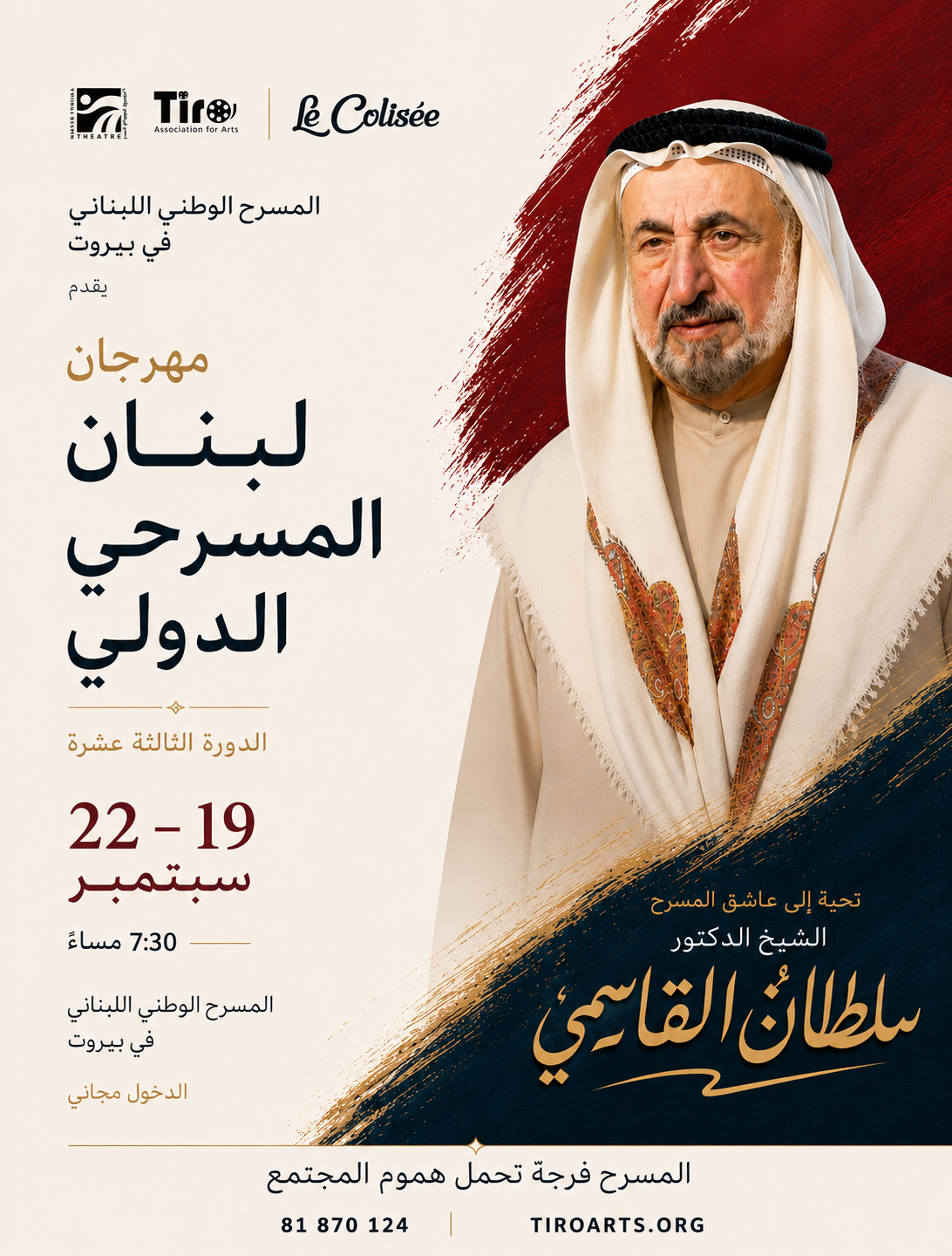
Eighty years after it opened, the same hall is a theater again, and from September 19 to 22 it will host the 13th Lebanon International Theater Festival, with performances from Lebanon, the Arab world and beyond, all under one theme: "Theater is a spectacle that carries the concerns of society."
The sentence is not a slogan the organizers wrote for a poster. It is the words of His Highness Sheikh Dr. Sultan bin Muhammad Al Qasimi, Ruler of Sharjah, and this edition of the festival is a tribute to him: to his creation of the Arab Theatre Institute, his work preserving Arab heritage and identity, and his long support for Arab theater and youth. It was at his initiative that the UNESCO-Sharjah Prize for Arab Culture was established in 1998, one of the most important international awards for Arab culture. In 2023, the prize’s jury honored Kassem Istanbouli, the actor and director who leads the festival and founded the Lebanese National Theater, for his pioneering work reopening closed cinemas across Lebanon and building free, independent cultural spaces.
The building the festival happens in is the proof of that work. The Lebanese National Theater at Colisée Al Hamra is a cinema restored into a stage: after the Colisée closed, Tiro Association for Arts, which Istanbouli founded in 2014, took over the building in 2024 with a team of young volunteers and began bringing it back. In October of that year, war came back to Beirut and more than a million people in Lebanon were displaced. The half-restored cinema became a shelter; families slept on the stage and among the seats, as they did in the Tiro-run cinemas of Tyre and Tripoli. Photographs from those weeks show mattresses where the audience used to sit.
On September 13, 2025, the Colisée reopened as the Lebanese National Theater in Beirut. "We are happy to see this dream come alive in Beirut," Istanbouli said at the announcement of this year’s festival, "with the establishment of the Lebanese National Theater at the historic Coliseum Cinema, following its establishment in Tyre and Tripoli."
The dream has a long address list. Lebanon, unlike most countries, never had a national theater. Tiro changed that from the bottom up: the Rivoli in Tyre, closed for thirty years, reopened in October 2018 as the Lebanese National Theater, the country’s first free, independent, open-to-the-public national stage. Tripoli followed, with the Empire, the 1930s cinema in Al Tal. Beirut now makes three, and the festival has grown with them, from its beginnings in Tyre to this thirteenth edition in the capital.
Against a year like this one in Lebanon, that is the point. "The festival aims to confront the reality of war in Lebanon," Istanbouli said, "and affirm the importance of keeping theater open to people in times of both war and peace." His belief, repeated in his UNESCO-Sharjah citation, is that art is a right, not a luxury: a right that must reach "the poorest before the rich," in his words, and that cultural life cannot wait for calm. In March 2026, when war flared again, around fifty people arrived at the Rivoli in Tyre on their own, because the doors were open. The cinema had been a shelter; now it was a refuge of a different kind.
The four days at the Colisée carry eight theatrical performances from different Arab countries, running from the opening evening on Saturday, September 19, through Tuesday, September 22. [The companies' names and the daily show times go here once the final program is with us.] Entry is free and open to all ages.
For four nights, the stage where displaced families slept will hold actors from Lebanon, the Arab world and beyond. The seats will be full of people who came for the same reason they always came to the Colisée: to sit together in the dark and watch someone else’s story carry the concerns of their own society. That is what the festival’s theme promises, and it is what a building that has been a picture palace, a bomb shelter and a national stage knows how to do.
Practical information: the 13th Lebanon International Theater Festival runs September 19-22, 2026, at the Lebanese National Theater, Colisée Al Hamra, Hamra, Beirut. Opening evening: Saturday, September 19, 6:00 pm. Entry is free.