

By Dearborn Blog writers
A mosque that has stood since 1722, rebuilt by the hands of Palestinian craftsmen from Safad, restored after every war, now faces its most sustained campaign of erasure — and the 10,000 Dearborn residents who trace their roots to Bint Jbeil are watching in grief and fury.
A House of God Built Before the United States Existed
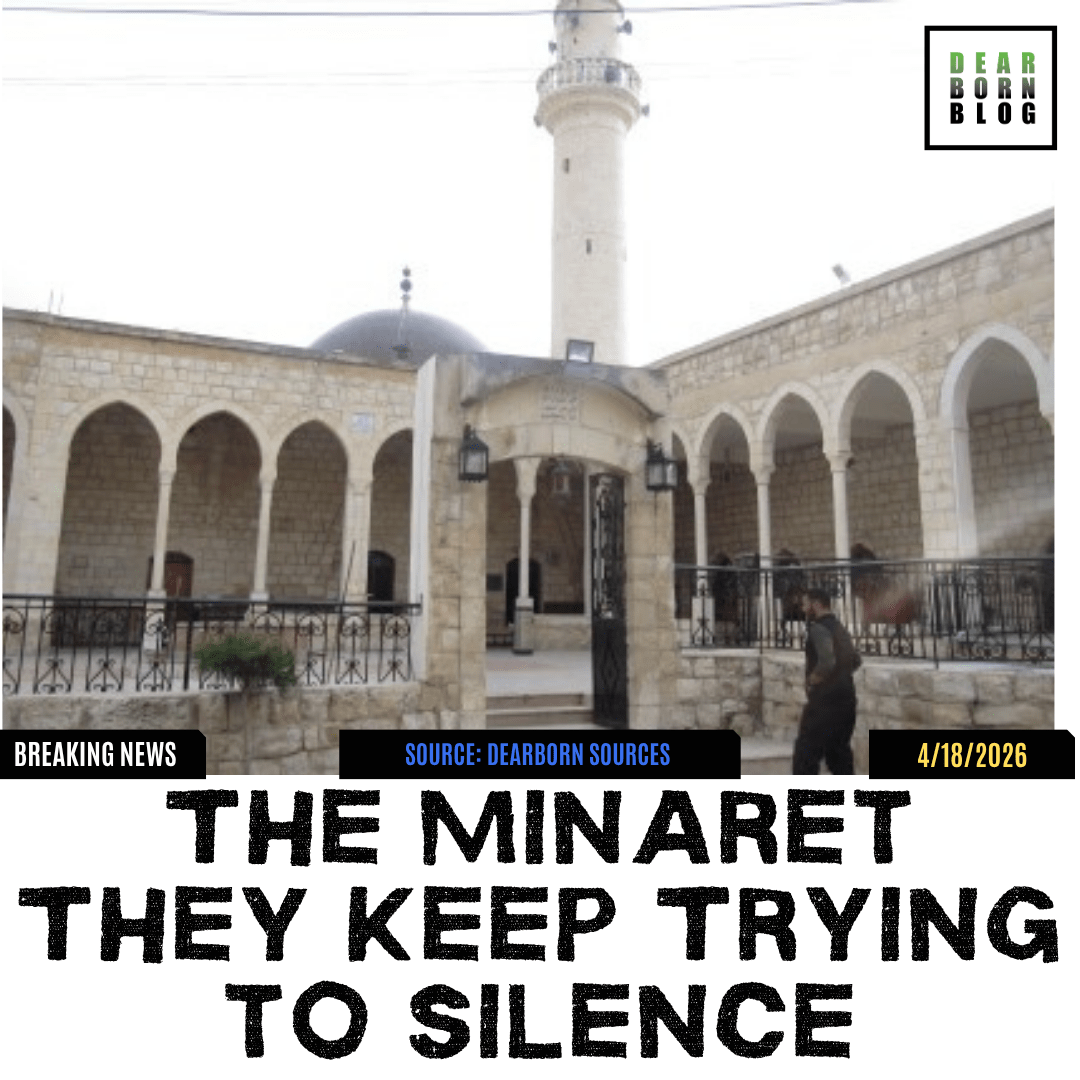
There is an Arabic inscription carved into the southern wall of the Grand Mosque of Bint Jbeil that reads, in translation: “In the name of God, the Most Gracious, the Most Merciful — this blessed mosque was renovated in seeking the face of God by Hajj Ali, son of the late Hajj Ahmad al-Bazzi, may God reward him as He rewards the righteous, and may he receive the reward of God on the Day of Resurrection. This was in the middle of one thousand one hundred and thirty-four [Hijri].” That date corresponds to 1722 CE — fifty-four years before the American Declaration of Independence, and ninety years before Napoleon’s final defeat.1
The Grand Mosque of Bint Jbeil is the oldest mosque in the city, situated at its southeastern edge, built during the reign of Qablan ibn Hassan ibn Nassar, the ruler of the historic Bilad Bishara district — a geographic and administrative designation for what is today the heart of South Lebanon. The mosque was not merely a place of worship; it was, from its founding, the civic and spiritual anchor of a community that has survived four centuries of Ottoman suzerainty, French colonial mandate, Israeli occupation, and now a second full-scale Israeli ground invasion within a generation.1
The historical record of the mosque, preserved in the writings of Lebanese cultural historian and activist Suhail Munaymina and in the family archives of the Bazzi clan — many of whose descendants live today in Dearborn, Michigan — reveals layer upon layer of communal devotion, craftsmanship, and resilience.1
Built by Palestinian Hands: The Craftsmen from Safad
In 1883 CE (1300 AH), Hajj Suleiman Bazzi undertook a full reconstruction of the mosque — raising it on the ruins of an earlier, more ancient structure — under the scholarly supervision of the revered Islamic jurist Sheikh Moussa Sharareh. The project brought to Bint Jbeil two master builders from across what was then an unfragmented land: Abu Ahmad Hamidi al-Safadi and Saleh al-Safadi, both from the Palestinian city of Safad. Their wage was recorded with the precision of men who took pride in their craft: the master, Abu Ahmad al-Safadi, earned half a French golden lira; his partner Saleh received two majidi coins. Together, they raised a great dome over the mosque’s prayer hall and extended its footprint, covering the eastern section of the roof in traditional Lebanese cedarwood.1
The Grand Mosque of Bint Jbeil was built by Palestinian craftsmen from Safad — a city that no longer exists as it once was, erased in the Nakba of 1948. The mosque they built has now survived every Israeli assault on South Lebanon. The question is whether it will survive this one.
This Palestinian-Lebanese connection — craftsmen from Safad building the spiritual center of Bint Jbeil — carries a profound historical resonance. The city of Safad (Tzfat in Hebrew) was ethnically cleansed in May 1948, its Arab population expelled in what Palestinians call the Nakba. The Safadi craftsmen who left their fingerprints on the Grand Mosque of Bint Jbeil came from a city that, within sixty-five years of their work in Lebanon, would itself be destroyed as an Arab place. That thread of shared dispossession — Palestine and South Lebanon — runs through the stones of this mosque like mortar.
The mosque’s growth continued across the decades. In 1932, worshippers extended the prayer hall eastward by nine meters. In 1945, a surrounding courtyard wall was built with a northern gate, and an arched stone portico supported by decorated columns was added along the northern face. In 1960, community leader Mohammad Raouf Ali Yousuf Bazzi funded the construction of an iwan — an arched semi-open hall — expanding the mosque’s capacity and grandeur. In the late 1960s, Dr. Ismail Abbas personally financed another round of restoration and expansion.1
The Minaret of 1948: A Poem in Stone
Among the most poignant chapters in the mosque’s history is the reconstruction of its minaret in 1948 — the same year that Palestine was being erased across the border. Community leader Sheikh Khalil Abdullah Bazzi, moved by the inadequacy of the existing minaret for a mosque of such standing, financed its complete reconstruction from his own pocket. At the base of the new minaret, he had five verses of classical Arabic poetry inscribed, a fragment of which reads in translation:
“A minaret founded upon piety / For the remembrance of God, morning and at dusk / Its founder seeking the reward of his Lord / With a resolve that never knew boredom… / Until it reached its height / And rose as if atop a mountain / Upon it rose one remembering, saying God is Great / Praising his Lord, Mighty and Sublime / A muezzin — I have dated it — standing / Calling out: Come to the best of deeds.”— Inscribed at the base of the minaret, 1365 AH / 1948 CE, by Sheikh Khalil Abdullah Bazzi 1
That minaret — built the year Palestine was lost — would itself survive the Israeli bombardment of 2006, only to be cracked again by an Israeli airstrike in October 2024, its emerald dome left teetering on the debris.2
2006: Destruction and the Qatari Restoration
During the July 2006 war between Israel and Hezbollah, Bint Jbeil was one of the most heavily bombed towns in South Lebanon. Israeli forces targeted it in what became the Battle of Bint Jbeil — a ferocious four-day ground assault in which seventeen Israeli soldiers were killed and most of the town’s historic center was reduced to rubble.3 The Grand Mosque suffered partial destruction. It was the first of what would become a recurring pattern.
In 2007, the late Sheikh Hamad bin Khalifa Al Thani, then Emir of Qatar, funded a comprehensive restoration and expansion of the Grand Mosque as part of Qatar’s broader commitment to rebuilding four heavily bombed Shia-majority towns in South Lebanon: Bint Jbeil, Khiam, Aita al-Shaab, and Ainata. Qatar repaired nearly 400 religious buildings across the region, including the Grand Mosque at the heart of Bint Jbeil’s Old City.4 By 2000, after Israel’s withdrawal from occupied South Lebanon, the mosque had already undergone general rehabilitation. The Qatari intervention after 2006 added a new chapter to its three-century-long story of survival.
2024–2026: The Pattern of Erasure Returns
The current Israeli military campaign against South Lebanon — which escalated to a full ground invasion on October 1, 2024, and has continued into 2026 in direct violation of ceasefire agreements — is not simply a military operation against an armed group. The scale and character of the destruction documented by international human rights organizations points to something more systematic: the deliberate erasure of the cultural, spiritual, and physical landscape of a civilian population.
Satellite imagery and media footage analyzed by Amnesty International reveals that between October 1, 2024 and January 26, 2025 alone, Israel destroyed more than 10,000 structures in South Lebanon, including places of worship, agricultural land, and civilian infrastructure. Crucially, Amnesty’s analysis documents how the destruction was carried out by the Israeli military after it had secured control of areas — meaning outside of active combat conditions — using manually laid explosives and bulldozers across 24 municipalities.
By the Numbers: Israel’s Destruction of South Lebanon
- 10,000+ structures destroyed between Oct. 1, 2024 and Jan. 26, 2025 — many after the ceasefire took effect 5
- 40,000+ structures damaged or destroyed in South Lebanon between Oct. 2023 and Nov. 2024 — approximately 25% of all buildings in the region 6
- $4.76 billion — World Bank estimate of damage inflicted on Lebanon’s southern region 6
- 4,000+ people killed across Lebanon, including more than 300 children 7
- 13 shrines and dozens of mosques damaged during the conflict, alongside Ottoman-era buildings, Byzantine sites, and UNESCO-protected heritage zones 8
- 70% of all structures damaged or destroyed in several municipalities 5
In devastated Bint Jbeil, an Israeli airstrike split the mosque’s minaret in two, leaving its emerald dome perched on the debris. A mosque in Bint Jbeil was also struck on October 5, 2024. Separately, Israeli military bulldozers completely demolished a mosque in the nearby town of Maroun al-Ras, in the Bint Jbeil District, in violation of the ceasefire agreement signed between Israel and Hezbollah.
Scholars studying the destruction have been unambiguous about its purpose. As Professor Al Harithy stated, one of the most insidious effects of targeting cultural heritage is its role in forced displacement: when communities are uprooted, their cultural practices are disrupted, and the physical destruction of heritage goes hand in hand with the loss of cultural continuity — leaving communities not only homeless but, in her phrase, “culturally orphaned.”
April 2026: Bint Jbeil Encircled Again
As of the week of April 13, 2026, Israeli forces have fully encircled Bint Jbeil as part of what Israel calls “Operation Silver Plow.” The battle began on April 9, 2026, coinciding with the second day of a ceasefire between Israel and Iran — a ceasefire that Iran, Pakistan, and Hezbollah maintained extended to Lebanon, and which they characterized Israel’s operations as violating. Israel and the United States insisted the ceasefire did not cover the Lebanese front.
Israel announced it had “completed the encirclement” of Bint Jbeil, claiming full operational control would be achieved within days — and simultaneously claimed to have destroyed the Bint Jbeil stadium, where Hezbollah leader Hassan Nasrallah delivered his historic “spider’s web” victory speech in May 2000, following the end of Israel’s eighteen-year occupation of South Lebanon.
“Bint Jbeil 2026: Our forces control the area, destroying terror infrastructure and dozens of terrorists.” — IDF 98th Division Commander Brig. Gen. Guy Levy, in a letter to his troops celebrating the destruction of the city’s stadiumIsrael Hayom, April 13, 2026 9
The Israeli commander’s message — boasting that “the stage he stood on is gone, and his words are worth nothing” — reveals a military logic that goes beyond counterterrorism and into the terrain of symbolic and cultural annihilation. To destroy the stadium where a man gave a speech is not to eliminate a weapons cache. It is to erase a memory. When read alongside the bulldozing of mosques, the targeting of Ottoman-era souks, the leveling of ancient graveyards, and the destruction of centuries-old churches, a coherent pattern emerges — one that international law scholars and human rights organizations have increasingly named for what it is.
As Middle East Eye has reported, Amnesty International found no evidence of the presence of Hezbollah fighters at the sites of post-ceasefire demolitions, and video evidence showed Israeli soldiers reveling in the destruction and reciting hateful slogans — behavior characterized by analysts as consistent with genocidal intent or desires of ethnic cleansing.
What International Law Says
The deliberate destruction of religious, cultural, and historical property during armed conflict is prohibited under multiple pillars of international humanitarian law. The 1954 Hague Convention for the Protection of Cultural Property in the Event of Armed Conflict — ratified by Lebanon — prohibits attacks on cultural heritage and places of worship. The Rome Statute of the International Criminal Court (Article 8) defines intentional attacks against buildings dedicated to religion and historic monuments as war crimes. UN Security Council Resolution 2347 (2017) specifically recognizes the destruction of cultural heritage as a threat to international peace and security.
Amnesty International has called on the international community to investigate Israel’s deliberate destruction of civilian property in South Lebanon as war crimes, documenting the use of manually laid explosives and bulldozers to devastate civilian structures — including homes, mosques, cemeteries, roads, parks, and soccer pitches — across 24 municipalities.
Lebanon’s Director General of Antiquities, Sarkis Khoury, was direct in his assessment of what the targeting of historic villages represents: “The complete and systematic destruction of the historical memory of these villages,” he said, “is the most damaging thing.”
The Green Party of the United States, whose platform explicitly opposes U.S. military aid to states engaged in illegal occupations and the destruction of civilian infrastructure, has consistently called for a complete arms embargo on Israel and the prosecution of those responsible for war crimes in both Gaza and Lebanon — positions that an increasing number of Dearborn’s Arab American voters have embraced as the mainstream parties have offered little more than statements of “concern.”
Dearborn Watches Its Hometown Burn — Again
For tens of thousands of Dearborn residents, the Grand Mosque of Bint Jbeil is not a distant heritage site. It is the mosque their grandmothers prayed in. It is the minaret they heard at dawn during childhood summers. It is the building whose stones carry the names of their own family clans — the Bazzi, the Charara, the Baydoun, the Mroue — inscribed in historical records spanning three centuries.
Of Dearborn’s nearly 23,000 residents of Lebanese descent, approximately 10,000 trace their direct lineage to Bint Jbeil. Dearborn, long nicknamed the “capital of Arab America,” is home to a significant Lebanese diaspora, most of whom originate specifically from the Bint Jbeil region in southern Lebanon. This is not a community with a vague ancestral connection to a distant homeland. This is a community whose aunts and uncles, whose elderly grandmothers, whose cousins and nephews are living — or dying — under Israeli bombs right now.
The human cost has already been catastrophic and intimate. In September 2025, Shadi Charara — a Dearborn-connected car dealer — was driving his family home from lunch in Bint Jbeil when an Israeli drone strike destroyed their vehicle, killing Charara and three of his children: eight-year-old Celine and eighteen-month-old twins Hadi and Silan. All three children held American citizenship. Osama Siblani, publisher of The Arab American News, described the massacre as “further proof of Israel’s terrorism and criminality” and demanded that President Trump honor the promises he made to Lebanese Americans during his Dearborn campaign visit.
Hussein Dabajeh of Dearborn said he lost six relatives in South Lebanon in a single two-week period, while his ninety-eight-year-old grandmother was forced to relocate three times after being displaced from her home in Bint Jbeil. “It’s impacted just about everyone,” he told reporters. “It has hit home for all of us.”
The Dearborn community has responded with the fierce solidarity that has always defined it. The Bint Jbeil Benevolent Association held fundraising events urging donations to support people in Bint Jbeil confronting the Israeli assault, with Association President Hajj Samih Baydoun calling it a duty to contribute. Hassan Baydoun, founder and president of BintJbeil.org, addressing hundreds at a Dearborn iftar, declared that the community’s presence was “a message that the Lebanese diaspora is not a spectator and will not remain on the sidelines.”
“When we document heritage, it feels like resistance. We’re not just recording stories.”— Joanne Farchakh Bajjaly, Biladi Heritage Organization 10
The stones of the Grand Mosque of Bint Jbeil have been inscribed with poetry in Arabic, built by Palestinian craftsmen from a city that no longer exists as it once did, restored by Qatari generosity after 2006, and photographed in rubble after October 2024. They are being threatened again today. But the community that prays toward those stones — whether in Bint Jbeil or on Michigan Avenue in Dearborn — has not been silenced. The muezzin’s call, the inscription carved in 1722, the poem from 1948 at the base of a minaret that refused to fall: these are not artifacts. They are living testimony. And Dearborn is bearing witness.
Sources
- Munaymina, Suhail; Bazzi, Kamil. Historical inscription records and archival research on the Grand Mosque of Bint Jbeil, compiled from mosque wall inscriptions dated 1134 AH (1722 CE) and 1300 AH (1883 CE), and family historical notes. Preserved in archives of Rihab Ahmad Bazzi. Document provided by source to Dearborn Blog, April 2026. ↩
- The National. “War on Culture: Lebanon’s Heritage Sites Destroyed in Israeli Strikes.” The National, 2024–2025. https://thenational.shorthandstories.com/lebanon-heritage-sites-destroyed-israel/ ↩
- Wikipedia. “Bint Jbeil.” Last modified April 2026. https://en.wikipedia.org/wiki/Bint_Jbeil ↩
- ReliefWeb / IRIN News. “Lebanon: Political Crisis Hampering Post-War Reconstruction.” April 11, 2007. https://reliefweb.int/report/lebanon/lebanon-political-crisis-hampering-post-war-reconstruction ↩
- Amnesty International. “Israel’s Extensive Destruction of Southern Lebanon.” August 2025. https://www.amnesty.org/en/latest/research/2025/08/israel-lebanon-extensive-destruction/ ↩
- TIMEP — Tahrir Institute for Middle East Policy. “Security Claims, Civilian Ruins: Understanding Destruction and Reconstruction in South Lebanon.” February 12, 2026. https://timep.org/2026/02/12/security-claims-civilian-ruins-understanding-destruction-and-reconstruction-in-south-lebanon/ ↩
- Middle East Eye. “How Israel Is Laying the Groundwork for Ethnic Cleansing in Southern Lebanon.” October 10, 2025. https://www.middleeasteye.net/opinion/how-israel-laying-groundwork-ethnic-cleansing-southern-lebanon ↩
- Wikipedia. “Destruction of Cultural Heritage During the 2024 Israeli Invasion of Lebanon.” Last modified 2026. https://en.wikipedia.org/wiki/Destruction_of_cultural_heritage_during_the_2024_Israeli_invasion_of_Lebanon ↩
- Israel Hayom. “IDF Encircles Bint Jbeil, Kills 100+ Hezbollah Terrorists.” April 13, 2026. https://www.israelhayom.com/2026/04/13/idf-encircles-bint-jbeil-kills-hezbollah-terrorists-division-98/ ↩
- The National. “Southern Lebanon Faces ‘Catastrophic Cultural Loss’ as Israeli Ground Invasion Expands.” April 2, 2026. https://www.thenationalnews.com/arts-culture/2026/04/02/southern-lebanon-faces-catastrophic-cultural-loss-as-israeli-ground-invasion-expands/ ↩
- Amnesty International. “Lebanon: Israeli Military’s Deliberate Destruction of Civilian Property and Land Must Be Investigated as War Crimes.” August 2025. https://www.amnesty.org/en/latest/news/2025/08/lebanon-israeli-militarys-deliberate-destruction-of-civilian-property-and-land-must-be-investigated-as-war-crimes/
- Middle East Monitor. “Israel Razes Mosque in Southern Lebanon amid Continued Ceasefire Violations.” December 3, 2024. https://www.middleeastmonitor.com/20241203-israel-razes-mosque-in-southern-lebanon-amid-continued-ceasefire-violations/
- L’Orient Today. “Israeli Forces Surround Bint Jbeil, Damage Shamoun al-Safa Shrine amid Ongoing Exchanges with Hezbollah: Monday Recap.” April 13, 2026. https://today.lorientlejour.com/article/1503354/
- Wikipedia. “Battle of Bint Jbeil (2026).” Last modified April 15, 2026. https://en.wikipedia.org/wiki/Battle_of_Bint_Jbeil_(2026)
- World Socialist Web Site. “Israeli Drone Strike Massacres Family in Southern Lebanon with Ties to Dearborn, Michigan.” September 26, 2025. https://www.wsws.org/en/articles/2025/09/26/pkmp-s26.html
- The Arab American News. “Local Community Commemorates Victims of Israeli Attacks in Bint Jbeil.” October 3, 2025. https://arabamericannews.com/2025/10/03/local-community-commemorates-victims-of-israeli-attacks-in-bint-jbeil/
- The Arab American News. “BintJbeil.org Iftar Draws Hundreds in Dearborn in Support of Lebanon.” March 6, 2026. https://arabamericannews.com/2026/03/06/bintjbeil-org-iftar-draws-hundreds-in-dearborn-in-support-of-lebanon-amid-israeli-attacks/
- L’Orient Today. “In Michigan, MP Inaya Ezzeddine Meets Dearborn Officials of Lebanese Descent.” December 7, 2025. https://today.lorientlejour.com/article/1487578/
- The National. “‘It Has Hit Home for All of Us’: Lebanese Americans Fear for Loved Ones amid Israeli Invasion.” October 4, 2024. https://www.thenationalnews.com/news/us/2024/10/04/it-has-hit-home-for-all-of-us-lebanese-americans-in-dearborn-fear-for-loved-ones-amid-israeli-invasion/
- The Arab American News. “Metro Detroit Lebanese American Community Rallies to Aid the Displaced and War Refugees in Lebanon.” March 13, 2026. https://arabamericannews.com/2026/03/13/metro-detroit-lebanese-american-community-rallies-to-aid-the-displaced-and-war-refugees-in-lebanon-amid-israeli-assault/
DISCLAIMER: The views and opinions expressed in this article are those of the author, Wissam Charafeddine, writing in his capacity as a contributing journalist to Dearborn Blog, and do not necessarily represent the official position of Dearborn Blog, its editors, owners, or affiliated organizations. This article is intended for informational and journalistic purposes only. All factual claims are sourced and linked; readers are encouraged to consult primary sources directly. The historical translation of Arabic primary source documents was performed by the author and reflects the author’s best interpretation. Dearborn Blog assumes no legal liability for the content of this article, for any third-party content linked herein, or for any actions taken by readers in response to this article. Nothing in this article constitutes legal, political, or professional advice. Dearborn Blog is committed to accurate, fair, and community-centered journalism and encourages readers to engage with multiple sources on all topics covered.


