

Where All Prayers Rise: Ten Faiths Unite in Livonia
On May 7, 2026, Madonna University’s Welcome Center became a sanctuary without walls — a place where the Qur’an and the Bhagavad Gita, Gurbani and the Sigrdrífa Prayer, the Sh’ma and Nam-Myoho-Renge-Kyo all rose together in one room. The Livonia Bridging Hearts 2nd Annual Day of Unity & Prayer was not a symbolic gesture. It was a living declaration that the moral imagination of Metro Detroit refuses to be narrowed by the politics of fear.
A Sacred Threshold at Madonna University
When guests walked through the doors of Madonna University’s Welcome Center on the evening of May 7, they were greeted not by a single tradition claiming the room, but by all of them at once. Faith tables stretched across the hall, each representing a distinct tradition — Native and Indigenous sacred elements alongside Hindu artifacts, Buddhist philosophy texts beside Jewish ceremonial objects, Muslim calligraphy beside Bahá’í artistic expressions, Pagan symbolic elements beside Sikh scripture. Representatives from each tradition stood ready not to recruit, but to share, answer questions, and engage in the kind of unhurried, genuine dialogue that rarely happens in a polarized public square.[1]
Madonna University is a private Catholic institution founded by the Felician Sisters in 1937, rooted in a Franciscan spirit of openness and service. Its campus ministry has long welcomed students of all faiths on their spiritual journeys.[2] That institutional ethos made it a fitting host for an event that had grown, in just its second year, into one of the most ambitious interfaith gatherings in the Detroit metro region. Dr. Christopher Dougherty delivered the university’s official welcome, setting the tone for an evening determined to honor difference without flattening it.
Serving as Master of Ceremony was Steve Spreitzer, a figure whose three decades of interfaith and racial justice work across Southeast Michigan have made him one of the most trusted conveners in the region. Spreitzer leads the InterFaith Leadership Council of Metropolitan Detroit and previously served as President and CEO of the Michigan Roundtable for Diversity and Inclusion. He has received recognition from the World Sabbath for Religious Reconciliation, the Council of Islamic Organizations of Michigan, the Catholic Youth Organization, and the Hindu American Foundation — a cross-traditional honor roll that speaks to his rare ability to hold space for all without privileging any.[3]
Ten Traditions, One Sacred Prayer Circle
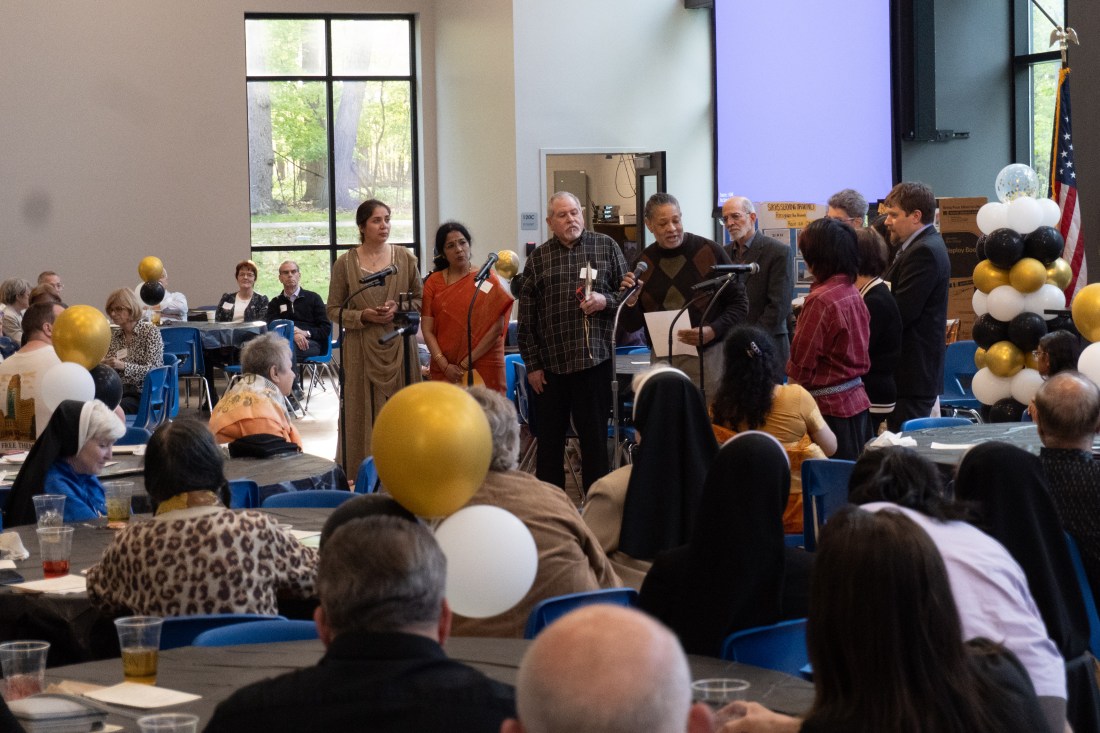
The event’s spiritual centerpiece was the Sacred Interfaith Prayer Circle — faith leaders arranged in a semi-circle, each offering prayer in their native language, each followed by an English translation. In an age when language is routinely weaponized, this structure made a quiet but profound argument: that the unfamiliar tongue of another’s prayer deserves not suspicion, but attentive respect.
Bud Riddle opened with a Native and Indigenous Traditional Prayer, accompanied by sacred elements that grounded the evening in the land itself — a reminder that all interfaith dialogue on this soil begins with an acknowledgment of those who held it first. Meenakshi Rajachudamani then offered verses from the Bhagavad Gita, the ancient Hindu scripture whose teachings on duty, devotion, and the unity of the divine have guided hundreds of millions across millennia. Nolan Munce of Soka Gakkai International offered the Buddhist chant Nam-Myoho-Renge-Kyo, a practice grounded in the conviction that every individual life contains the potential for enlightenment and the capacity to transform suffering into value.
Gail Katz offered the Sh’ma, Judaism’s central declaration of divine oneness — words carried through centuries of dispersion and persecution, now spoken in peace in a university hall in Livonia. Layal Boussi recited from the Qur’an on the themes of Oneness and Unity, the tawhid that forms Islam’s theological and moral foundation. Jesse Cox represented Christianity with a reflection titled “Interrupting the Silence” — an evocative phrase in a national moment when silence in the face of injustice has itself become a political act. Inderpaul Singh performed Gurbani Shabd, the sacred hymns of Sikhism that affirm the equality of all human beings before the one Creator. Farideh Kian offered the Bahá’í Prayer for Unity, with an English translation by Will Morrison. And Jaron Ho closed the circle with the Pagan Sigrdrífa Prayer, a Norse invocation of wisdom and protection that reminded the room how ancient and varied humanity’s conversations with the sacred truly are.
🔵 FAITH & COMMUNITY CONTEXT
Michigan is home to one of the largest and most diverse Muslim American communities in the United States, with deep roots in cities such as Dearborn, Hamtramck, Detroit, and beyond. The Michigan State Legislature recognized in a 2026 resolution that “Muslim Americans are leaders in promoting interfaith understanding, civic engagement, and community service, contributing to a more inclusive and equitable society.” [4] Events like Livonia Bridging Hearts are the grassroots expression of that leadership — not top-down, but built face-to-face, prayer by prayer, handshake by handshake.
Art, Culture, and the Flame That Cannot Be Silenced
If the prayer circle was the event’s soul, the interfaith art and cultural expression segment was its heartbeat. Tradition after tradition offered not argument but beauty — the universal grammar that no border can contain and no ideology can fully appropriate.
Students of KOOJUN Music Academy, directed by Rujuta Joshi, performed the Hindu welcome song “Suswagatam,” filling the room with an invitation that needed no translation. Bud Riddle returned with Native and Indigenous drum and sacred elements, anchoring the gathering once more in the rhythms that predate every institution in this region. Yevgeniya Gazman led a Jewish “Create Together” artistic expression — a participatory act that modeled rather than merely described the collaborative ethos the evening championed. Nolan Munce offered a presentation on Buddhist practice and peace philosophy through the lens of Soka Gakkai International, a global movement whose founder Daisaku Ikeda devoted his life to cultural exchange and nuclear abolition as twin pillars of lasting peace.
Mary Ann Smith performed “Panis Angelicus,” the 13th-century Latin hymn whose title translates to “Bread of Angels” — a piece that has moved listeners across eight centuries precisely because its longing for the sacred transcends the boundaries of its own tradition. Sikh Youth performed Gurbani Shabd in devotional singing, their voices part of a centuries-long tradition of langar — radical welcome. Anna Morrison & Friends offered the Bahá’í vocal performance “Let the Flame,” a piece whose title resonated throughout the evening as a metaphor for the kind of unity that doesn’t neutralize difference but ignites it into something greater. And Jaron Ho closed the cultural program with a Pagan visual display and symbolic elements — a reminder that reverence for the earth and the cycles of life is itself a spiritual tradition with deep roots.
🔴 WHY INTERFAITH WORK MATTERS NOW
The greater Detroit area is home to more than 200,000 Arab Americans — one of the largest concentrations in the United States.[5] That community, built over more than a century, is religiously plural: Lebanese Christians arrived first in the 1880s, followed by Palestinian Muslims, Catholic Chaldeans from Iraq, Yemenis, Syrians, and others.[6] In November 2025, when anti-Islam agitators again attempted to use Dearborn as a staging ground for division, faith and civic leaders responded with a unified press conference at the Interfaith Center on Ford Road — a building that houses both Islamic and Christian institutions side by side.[7] The message was unambiguous: Dearborn’s pluralism is not a vulnerability. It is its greatest strength.
“Habeebona El Mostafa”: A Muslim Voice at the Heart of the Chorus
No moment in the evening carried more symbolic weight than the performance by the Voices of Salaam Choir. Introduced by Lana Moussa, the choir performed “Habeebona El Mostafa” — an Arabic tribute to the Prophet Muhammad, peace be upon him, whose name translates as “Our Beloved, the Chosen One.” That a Muslim devotional tribute to the Prophet was welcomed, introduced, and celebrated within a ten-faith interfaith gathering is itself a statement about what genuine pluralism looks like.
In a political environment where Muslim religious expression has been caricatured, surveilled, and suppressed — where the post-9/11 era left many mosques either turning inward or perpetually engaged in the exhausting work of explaining themselves to a suspicious public[8] — this was something different. It was Muslim sacred love poetry, in Arabic, received not as a threat but as a gift. The Voices of Salaam Choir did not have to translate their devotion into a form palatable to others. They simply offered it, and the room received it.
“The deeper courage we are called to practice is not simply standing against what is wrong — it is reaching out with humanity and love, even when it is hardest.”Steve Spreitzer, Master of Ceremony & InterFaith Leadership Council of Metropolitan Detroit[9]
That spirit animated every choice made by the Livonia Bridging Hearts organizers. The short film “Doors Opened: A Journey Through Faith and Friendship” served as a narrative spine for the evening — a visual essay on what happens when misconceptions lose their grip, when doors between communities are pushed open rather than bolted shut. It was screened as a transition between the prayer circle and the cultural performances, reminding the audience that what they were witnessing was not a performance of tolerance but the product of actual relationships built over time.
The Unity Mural: Every Hand a Signature on Shared Humanity
The evening closed not with a speech but with an act. Guests were invited to contribute to a Unity Mural — adding drawings, messages, and reflections representing unity, peace, and shared humanity. In a media landscape saturated with comment sections designed to provoke outrage, there was something quietly radical about a wall that invited people to add rather than argue, to leave a mark of care rather than a wound.
Steve Spreitzer’s career is built on the conviction that these acts of creative encounter have a cumulative political power. When anti-Muslim sentiment erupted in Kalkaska, Michigan in 2017, it was Spreitzer who helped residents reclaim their community’s narrative through exactly this kind of direct human engagement — organizing town halls on religious understanding, meeting resistance head-on, building bridges precisely where others had attempted to burn them.[10] What the Unity Mural invited guests to do in miniature, Spreitzer and his collaborators have been doing across Michigan for thirty years.
By 2023, Crain’s Detroit named Spreitzer a Notable Leader in DEI, recognizing that he had built a coalition of over 200 faith leaders to address affirmative action-related issues and curated a national exhibition on housing discrimination.[11] The Livonia Bridging Hearts gathering, now in its second year, is an extension of that institutional legacy — but it is also a grassroots creation, built by the faith communities themselves, and belonging to all of them equally.
🟡 GET INVOLVED: COMMUNITY ACTION STEPS
- Follow the InterFaith Leadership Council of Metropolitan Detroit at detroitinterfaithcouncil.com to stay connected to upcoming events and interfaith dialogue opportunities across the region.
- Attend next year’s Livonia Bridging Hearts Day of Unity & Prayer — as the 3rd Annual gathering takes shape, your presence is your vote for the world you want to live in.
- Visit a faith tradition you know nothing about. Call a mosque, a gurdwara, a Buddhist center, or a Bahá’í fireside in Dearborn or Livonia and ask if you can attend an open community event. Most will welcome you with food, warmth, and gratitude.
- Young people: register to vote and bring the values of this evening into every political choice. The Dearborn uncommitted movement showed the nation what community-grounded civic action looks like. Interfaith solidarity is its moral foundation.
Dearborn’s Voice and the Green Vision of a Pluralist Nation
Dearborn became the first Arab-majority city in the United States in 2023, with roughly 55 percent of its 110,000 residents claiming Middle Eastern or North African ancestry.[12] That demographic reality is not separate from Dearborn’s interfaith identity — it is its source. The city was built by waves of immigrants from Lebanon, Palestine, Yemen, Iraq, and Syria, each wave bringing its own mosques, churches, and community structures, and each finding ways to coexist with those who arrived before and after. Christians left Lebanon in the 1880s for freedom and factory jobs. Palestinian Muslims came after 1967. Catholic Chaldeans from Iraq and Syrian refugees followed decades later.[13] The result is a city where interfaith coexistence is not a program — it is a lived inheritance.
The Islamic Center of America on Ford Road — the largest mosque in North America — has long served as a hub not only for Muslim worship but for interfaith dialogue and civic engagement, open to all faiths and backgrounds, its programming extending from local food distribution to global relief drives.[14] When vandals struck its congregation in 2007, it was the broader Detroit community — Christians, Jews, and Muslims together — who responded with solidarity. Dearborn does not merely tolerate religious pluralism. It models it.
The Green Party of the United States, in its Ten Key Values, affirms that it is essential “to value cultural, ethnic, racial, sexual, religious and spiritual diversity, and to promote the development of respectful relationships across the human spectrum.”[15] That language maps directly onto what was built at Madonna University on May 7. It maps onto what Dearborn’s communities have been building for a century. Pluralism is not naïveté. It is the only politics large enough to hold the whole of humanity. And in Southeast Michigan, communities are proving it possible, one prayer, one mural, one opened door at a time.
“Anyone who says you can’t be both Muslim and American needs to go to Dearborn, which has the nation’s highest percentage of Arab American citizens.”Spiritual Travels, on the Arab American community of Dearborn, Michigan[16]
That sentiment applies with equal force to the Livonia Bridging Hearts gathering: anyone who believes that American civic life must be organized around religious exclusion, fear, or hierarchy needs to stand in a room where a Buddhist chant, a Jewish declaration, a Muslim recitation, a Sikh hymn, a Bahá’í prayer, a Native drum, and a Pagan invocation are all received as gifts — where the MC is a Catholic-raised diversity advocate who learned courage from a Sikh mentor, and where the closing act is a wall that belongs to everyone who touches it.
That is not the America being promised from certain podiums. But it is the America being built in Livonia and Dearborn, quietly and persistently, one gathering at a time. Dearborn’s communities, forged in generations of navigating difference and demanding dignity, have always known that solidarity is not sentiment — it is practice. The Livonia Bridging Hearts 2nd Annual Day of Unity & Prayer is that practice made visible. It deserves our attention, our participation, and our support.
Sources
- AllEvents.in, Livonia Day of Prayer and Unity, Madonna University, Livonia, MI, May 1, 2025. https://allevents.in/livonia/livonia-day-of-prayer-and-unity/200027990137548 ↩
- Madonna University Campus Ministry. Campus Ministry — Supporting Students of All Faiths. Madonna University. https://www.madonna.edu/resources/campus-ministry/ ↩
- Michigan Chronicle, Michigan Roundtable for Diversity and Inclusion President Talks Growth, May 4, 2022. https://michiganchronicle.com/2022/05/04/michigan-roundtable-for-diversity-and-inclusion-president-talks-growth/ ↩
- Michigan Legislature, Senate Resolution 2026-SER-0091: Designating January as Muslim American Heritage Month in Michigan, 2026. https://legislature.mi.gov/documents/2025-2026/resolutionenrolled/Senate/htm/2026-SER-0091.htm ↩
- Spiritual Travels, The Thriving Arab American Community of Dearborn, Michigan. https://www.spiritualtravels.info/spiritual-sites-around-the-world/north-america/dearborn-michigan/ ↩
- Our Sunday Visitor, Michigan Catholics, Muslims Model Coexistence, October 3, 2018. https://www.osvnews.com/2018/10/03/michigan-catholics-muslims-model-coexistence/ ↩
- Arab American News, Rejecting Religious Incitement: Dearborn Holds Major Press Conference Affirming City’s Unity, November 30, 2025. https://arabamericannews.com/2025/11/30/rejecting-religious-incitement-dearborn-holds-major-press-conference-affirming-citys-unity/ ↩
- University of Michigan-Dearborn, Arab Detroit Enters Its ‘Worldmaking’ Era, September 10, 2025. https://umdearborn.edu/news/arab-detroit-enters-its-worldmaking-era ↩
- InterFaith Leadership Council of Metropolitan Detroit, Courage to Reconcile: Steve Spreitzer. https://detroitinterfaithcouncil.com/courage-to-reconcile-steve-spreitzer/ ↩
- Not In Our Town, Learning from Michigan: How to Stand Up to Hate Crimes Together, September 21, 2016. https://www.niot.org/blog/learning-michigan-how-stand-hate-crimes-together ↩
- Crain’s Detroit Business, Steve Spreitzer — Notable Leaders in DEI 2023, November 13, 2023. https://www.crainsdetroit.com/recognitions/notable-leaders-in-dei/2023/steve-spreitzer-notable-leaders-in-dei-2023/ ↩
- The Conversation, A Brief History of Dearborn, Michigan — The First Arab-American Majority City in the US, October 15, 2024. https://theconversation.com/a-brief-history-of-dearborn-michigan-the-first-arab-american-majority-city-in-the-us-216700 ↩
- Our Sunday Visitor (2018), ibid. ↩
- Arab American News (Rakwa), Islamic Center of America: North America’s Premier Islamic Hub in Dearborn, July 29, 2025. https://news.rakwa.com/2025/07/29/islamic-center-of-america-north-americas-premier-islamic-hub-in-dearborn/ ↩
- Green Party of the United States, Ten Key Values. https://www.gp.org/ten_key_values ↩
- Spiritual Travels (2025), ibid. ↩
Legal Disclaimer
The content published on Dearborn Blog is intended solely for informational, educational, and civic commentary purposes. All information presented in this article is drawn from publicly available sources, official event programs, and published reports; citations are provided for all factual claims. Dearborn Blog makes no warranties, express or implied, regarding the completeness, accuracy, or timeliness of information derived from third-party sources, and readers are encouraged to verify information independently. The views expressed in this article represent the editorial perspective of the author and Dearborn Blog and do not constitute legal, medical, financial, or professional advice of any kind. Dearborn Blog does not assume liability for any actions taken or not taken based on the contents of this article. Inclusion of event participants, organizations, or institutions does not imply endorsement by or affiliation with Dearborn Blog. All third-party names, trademarks, and organizational identifiers referenced herein remain the property of their respective owners and are used solely for purposes of identification and journalistic commentary under fair use principles. For concerns or corrections, please contact the editorial team directly.
Faith leaders from diverse traditions gathered side by side in a semi-circle to offer prayers in their native languages — each centered on unity, peace, compassion, and our shared human experience. Every prayer was followed by an English translation, reminding us that while languages differ, the human spirit speaks clearly.
From Indigenous sacred traditions to the Bhagavad Gita, Buddhist chants, the Jewish Sh’ma, Qur’anic recitation, Christian reflection, Sikh Gurbani, Baháʼí prayers, and Pagan invocation — this gathering became a living reminder that coexistence is not weakness; it is civilization at its finest.
Featuring prayers presented by:
• Bud Riddle
• Meenakshi Rajachudamani
• Nolan Munce
• Gail Katz
• Layal Boussi
• Jesse Cox
• Inderpaul Singh
• Farideh Kian
• Will Morrison
• Jaron Ho
In a world addicted to division, moments like this feel almost revolutionary.
Performed by Students of KOOJUN Music Academy
Directed by Rujuta Joshi
Presentation on Buddhist Practice and Peace Philosophy
Presented by Nolan Munce
“Habeebona El Mostafa”- A Tribute to Prophet Muhammad, PBUH
Introduction by Lana Moussa
Performed by Voices of Salaam Choir
Performed by Sikh Youth


