

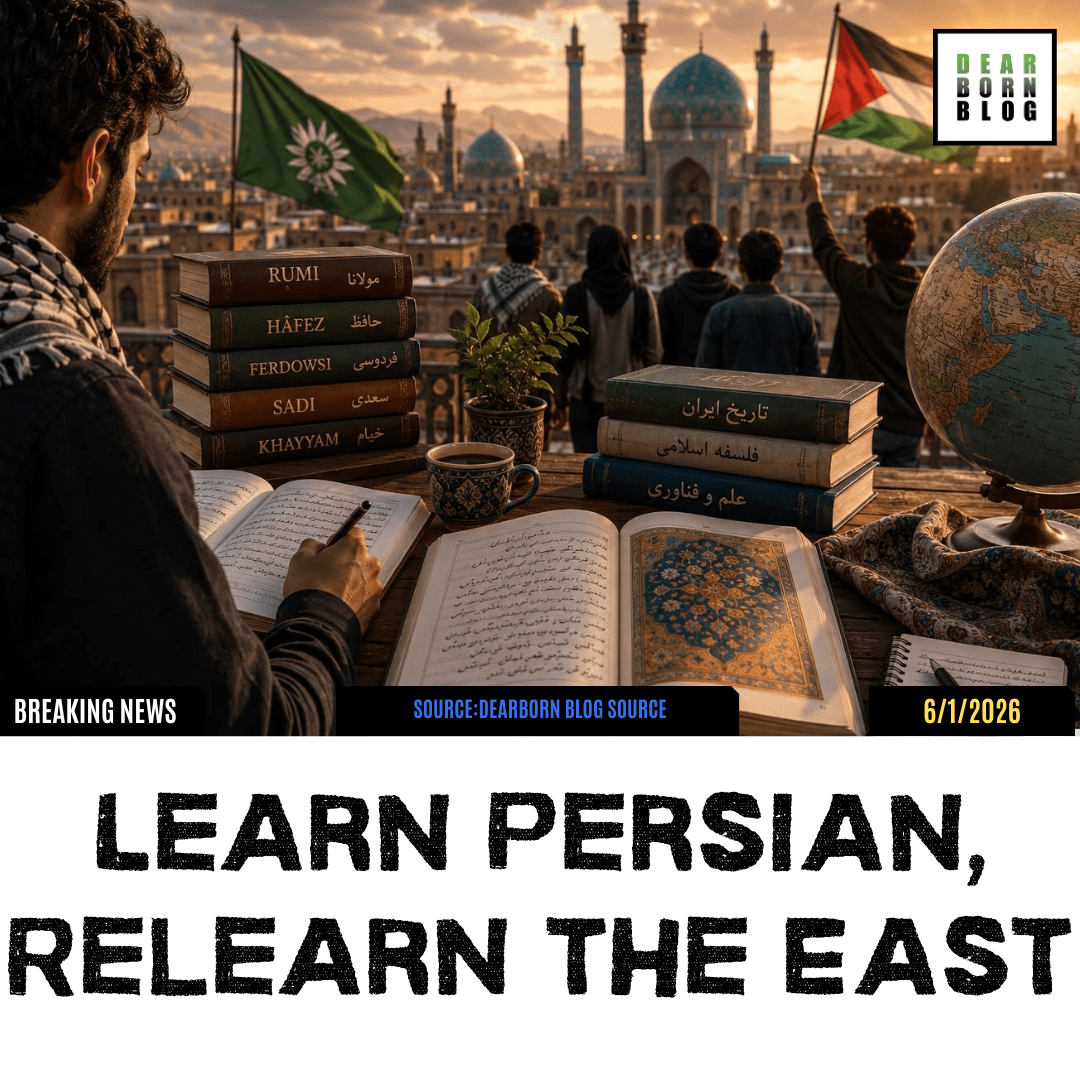
Learning Persian is not a betrayal of Arab identity. It is an intellectual investment in understanding the civilizations, cultures, and geopolitical realities shaping the future of the Middle East. Strong societies do not fear languages. They master them.
There is a reason short statements travel faster than long essays. Before the reader decides not to read them, they already have. But concise statements also carry a risk: people often interpret them according to their own fears, loyalties, and assumptions rather than the intention behind them.
That is exactly what happened after the statement:
“The Iranian era is coming — an era of prosperity, science, and technology. Arabs should learn Persian.”
Some readers treated it as a civilizational observation. Others treated it like ideological surrender. But the statement was never about abandoning Arab identity or embracing a political system. It was about understanding history, power, knowledge, and the future of the region.
The problem is that many modern political conversations happen inside a cycle of headlines, algorithms, outrage, and electronic tribalism. Civilizations do not move at the speed of Twitter posts. They move through centuries of culture, language, scholarship, trade, science, and intellectual exchange.
And history is very clear on one point: powerful civilizations learn languages. Declining civilizations fear them.
“Language is not political loyalty. It is access.”
Arabs Were Never Historically Monolingual
The irony is that the Arab world today is often less intellectually open than it was during its greatest eras.
The Abbasid era — commonly remembered as the golden age of Arab-Islamic civilization — was built on translation, exchange, and multilingual scholarship.[1] Baghdad’s Bayt al-Hikma (House of Wisdom) was not a fortress protecting Arabic from outside influence. It was a giant engine importing Persian, Greek, Syriac, and Indian knowledge into Arabic intellectual life.[2]
Arab scholars historically studied multiple languages because they understood something modern political discourse has forgotten: civilizations grow through interaction, not isolation.
Persian was not treated as an enemy language. It was part of the intellectual bloodstream of the Islamic East.
The Persian cultural sphere produced philosophers, poets, historians, scientists, theologians, and political thinkers whose influence extended across the Arab world for centuries.[3]
A civilization confident in itself does not panic when its people learn another language.
A civilization insecure about itself does.
Persian Is Bigger Than Modern Politics
One of the biggest intellectual mistakes in today’s Middle East is reducing ancient civilizations into temporary geopolitical rivalries.
Persian is not merely the language of a contemporary state. It is one of the major civilizational languages of Asia and the Islamic world.
Anyone who reads Rumi, Ferdowsi, Omar Khayyam, Saadi, Hafez, Ali Shariati, or Abdolkarim Soroush quickly realizes that Persian intellectual history is not peripheral to the region. It is foundational.[4]
Even many Arab scholars throughout history operated in Persian-speaking intellectual environments.
This is why serious scholars study languages even when they disagree politically with the governments associated with them.
People study English without becoming American nationalists.
People study French without becoming French imperialists.
People study Chinese without pledging loyalty to Beijing.
So why does Persian uniquely trigger panic among some people?
Because too many modern conversations about Iran are driven by propaganda instead of scholarship.
Understanding Iran Without Translation Filters
One of the biggest intellectual disasters in the modern Arab world is that many Arabs now understand the East primarily through Western translation and Western framing.
This is catastrophic for independent thinking.
How can Arabs claim to understand Iran, Central Asia, or Eastern Islamic intellectual traditions if they cannot read the languages of those societies directly?
Instead, many consume simplified narratives filtered through Western think tanks, Gulf media wars, or social media clichés.
This creates a strange situation where some Arabs know more about American domestic politics than they know about neighboring civilizations that have shaped the region for centuries.
“A reader trapped inside translation eventually becomes dependent on whoever controls the translation.”
Learning Persian is therefore not merely about language acquisition. It is about breaking intellectual dependency.
It allows Arabs to access Iranian scholarship, philosophy, literature, strategic thinking, journalism, cinema, and political debates without mediation.
That matters.
Especially in a region constantly manipulated by information warfare.
The Geopolitical Reality Many Refuse to Admit
Whether people like it or not, Iran has become one of the central powers shaping the future of the Middle East.[5]
This is not emotional attachment. It is geopolitical observation.
Iran possesses:
- major scientific infrastructure,
- advanced engineering sectors,
- regional military influence,
- strong educational institutions,
- technological growth,
- and a deeply rooted civilizational identity.
Sanctions slowed Iran. They did not erase it.
Despite decades of isolation campaigns, Iran developed significant domestic industries in science, medicine, engineering, and defense technology.[6]
This matters because history consistently shows that rising powers influence language trends.
In the twentieth century, people learned English because the United States became globally dominant.
Today, millions study Mandarin because China is rising economically and technologically.[7]
If Iran continues expanding scientifically, technologically, and economically within the region, Persian will naturally gain practical importance.
That is not ideology. That is how history works.
The Resistance Axis and the Language of Understanding
There is another dimension many critics intentionally ignore.
The struggle in the Middle East today is not only military. It is also cultural, informational, and intellectual.
Anyone seeking to seriously understand what is commonly called the “Axis of Resistance” cannot rely exclusively on Western media framing or fragmented Arab coverage.[8]
Whether one supports or opposes Iran politically, understanding requires direct access to the intellectual ecosystem shaping Iranian society.
Learning Persian becomes a strategic tool for understanding the region beyond propaganda.
This is especially important given the long-running efforts to culturally isolate Iran from Arab public consciousness.
The Western and Zionist narrative surrounding Iran often reduces an entire civilization into a caricature — a permanent villain stripped of complexity, history, and humanity.
That reduction benefits geopolitical agendas.
But serious intellectual work demands something else:
- reading primary sources,
- engaging original debates,
- understanding internal disagreements,
- and recognizing complexity.
Real scholarship cannot survive on slogans.
Fear of Persian Reveals Fear of Complexity
There is something psychologically revealing about people who fear languages.
Language learning expands nuance.
Nuance disrupts propaganda.
And propaganda depends on simplification.
Many political actors benefit from keeping Arabs intellectually disconnected from neighboring cultures.
Because once people read directly, they stop relying entirely on gatekeepers.
The modern Arab intellectual crisis is not a lack of intelligence. It is often a lack of curiosity.
A culture that only consumes translated summaries eventually becomes intellectually passive.
And passive societies are easier to manipulate.
“The intellectual who lacks linguistic curiosity slowly becomes a consumer of slogans instead of a producer of consciousness.”
Dearborn Understands Hybrid Identity Better Than Most
This conversation matters deeply in places like Dearborn.
Dearborn exists at the intersection of identities, languages, migrations, and civilizations. The city itself disproves the idea that learning another language threatens identity.
Dearborn Arabs speak Arabic and English.
Some also speak Spanish, French, Urdu, Turkish, or Farsi.
And none of that erases who they are.
In fact, multilingualism often strengthens identity because it gives people confidence instead of insecurity.
Dearborn’s Arab-American experience already demonstrates that communities can preserve culture while engaging broader worlds.
This is precisely why many conversations inside Dearborn increasingly challenge simplistic East-versus-West narratives.
As Dearborn Blog previously explored in discussions surrounding cultural identity, migration, and political consciousness, understanding the region requires rejecting both blind nationalism and blind Westernization. It requires intellectual independence.
And intellectual independence begins with direct access to knowledge.
The East Must Reconnect With Itself
Colonial fragmentation disconnected the peoples of the Middle East from one another.
Today, many Arabs know Europe better than they know Iran, Central Asia, or even parts of their own shared civilizational history.
That separation was not accidental.
Colonial systems often weaken regions by interrupting cultural continuity and replacing horizontal regional relationships with vertical dependency on imperial centers.[9]
Relearning regional languages is one way to reverse that process.
Not to erase Arab identity.
Not to dissolve borders.
Not to create ideological conformity.
But to rebuild intellectual bridges.
Because isolated societies are easier to dominate.
Connected societies are harder to manipulate.
This Is Not About Submission — It Is About Confidence
Some critics react to the idea of learning Persian as though identity itself is fragile.
But truly confident civilizations do not fear exchange.
Arabic survived centuries of interaction with Persian, Turkish, Greek, and European languages. It remains one of the richest languages on Earth.
Learning Persian does not weaken Arabic.
If anything, it deepens understanding of the broader Islamic and Middle Eastern intellectual world that historically evolved through multilingual interaction.
The real danger is not multilingualism.
The real danger is intellectual isolation.
And perhaps that is the central point.
The Arab who knows only English may understand how the West thinks about the East.
But the Arab who also knows Persian may finally begin understanding how the East thinks about itself.
Sources
[1] George Saliba, Islamic Science and the Making of the European Renaissance, MIT Press, 2007.
[2] Jonathan Lyons, The House of Wisdom: How the Arabs Transformed Western Civilization, Bloomsbury Press, 2009.
[3] Richard N. Frye, The Golden Age of Persia, Phoenix Press, 2000.
[4] Hamid Dabashi, Persophilia: Persian Culture on the Global Scene, Harvard University Press, 2015.
[5] Trita Parsi, Losing an Enemy: Obama, Iran, and the Triumph of Diplomacy, Yale University Press, 2017.
[6] Shahir Shahidsaless, “How Iran Built Scientific Capacity Under Sanctions,” Carnegie Endowment for International Peace, 2021.
[7] David Graddol, The Future of Language, British Council Reports, 2006.
[8] Nader Hashemi & Danny Postel, The People Reloaded: The Green Movement and the Struggle for Iran’s Future, Melville House, 2011.
[9] Edward Said, Orientalism, Pantheon Books, 1978.
Further Reading
For more perspectives on regional identity, political narratives, and intellectual independence, readers can explore previous analysis and commentary published on DearbornBlog.com regarding media framing, Orientalism, Palestine solidarity, and regional geopolitical discourse.
Disclaimer
This article is an opinion and analysis piece published by Dearborn Blog writers for informational and educational purposes only. The views expressed do not constitute legal, diplomatic, academic, or governmental advice. Dearborn Blog does not endorse violence, discrimination, or hatred against any people, nation, religion, or ethnicity. Readers are encouraged to conduct independent research, consult primary sources, and engage critically with all geopolitical narratives and historical interpretations discussed in this article.


