

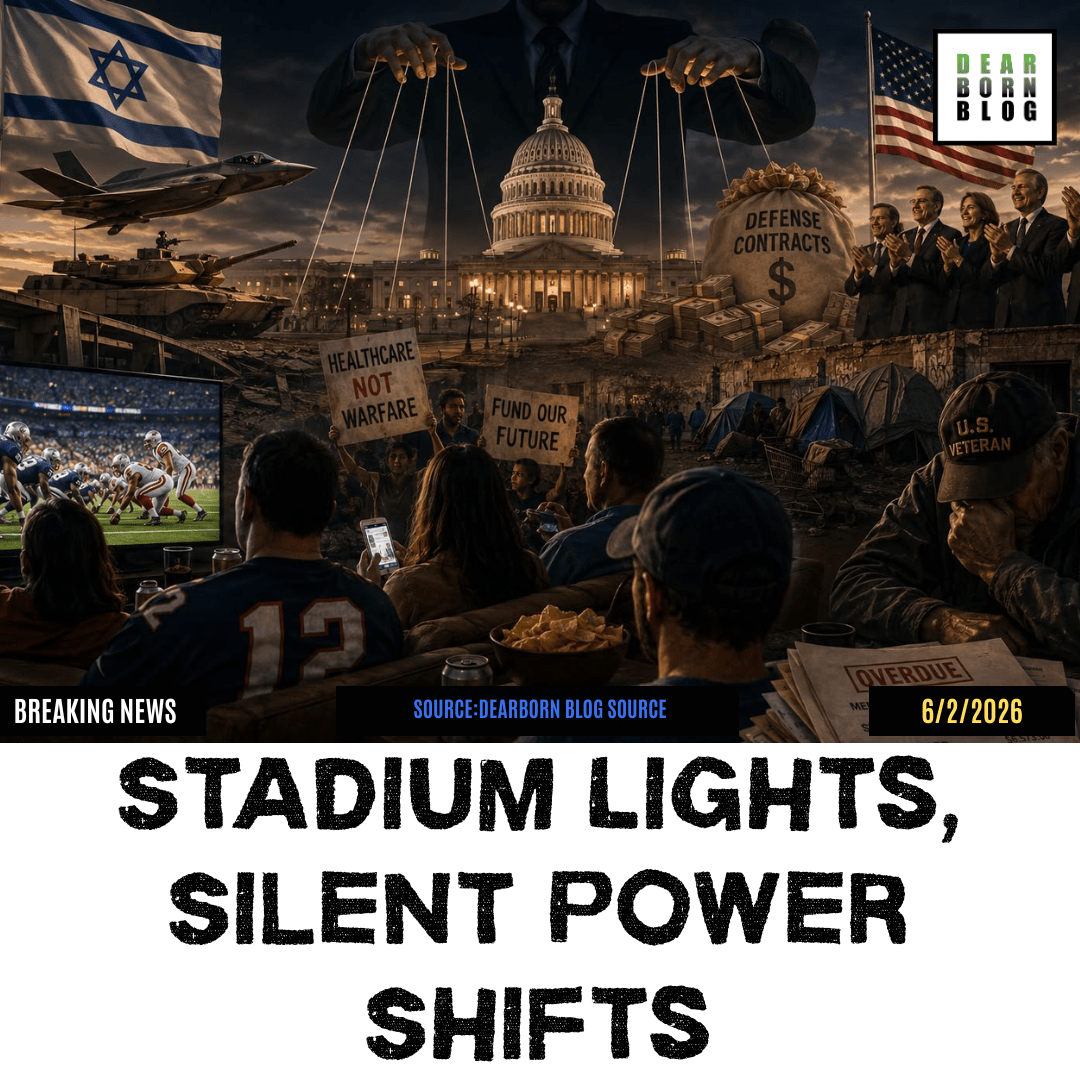
As Americans drown in debt, division, and distraction, Congress is quietly expanding one of the deepest military and technological partnerships in modern history. Buried inside defense legislation and bipartisan consensus lies a growing question few politicians dare to ask publicly: Who exactly is American power serving anymore?
America loves spectacle.
The Super Bowl.
The culture war.
Celebrity scandals.
Streaming binges.
The endless algorithmic carousel designed to keep citizens emotionally exhausted and politically anesthetized.
Meanwhile, something historic is happening in Washington in broad daylight — and most Americans have no idea it is unfolding.
Not through tanks rolling into cities.
Not through foreign flags flying over government buildings.
Not through soldiers landing on beaches.
But through lobbying networks.
Defense integration.
Joint military technology programs.
Political pressure campaigns.
And legislation quietly passed while the public argues online about distractions carefully engineered to consume attention.
The question is no longer whether Israeli influence inside American politics exists.
The real question is how deeply institutionalized it has become — and whether Americans still possess the political courage to discuss it openly without fear of professional or social destruction.
That distinction matters.
Because criticism of state influence is not hatred toward a people.
And yet in modern American political culture, those lines are deliberately blurred.
A Bipartisan Sacred Zone
One of the most striking realities in modern Washington is this:
On nearly every issue imaginable, Democrats and Republicans appear bitterly divided.
Healthcare.
Immigration.
Taxes.
Abortion.
Education.
Climate policy.
Ukraine.
China.
But when the subject becomes Israel, bipartisan unity suddenly materializes with astonishing speed.
Military aid packages pass overwhelmingly.
Weapons transfers move rapidly.
Public criticism becomes politically radioactive.
Members of Congress compete to demonstrate loyalty to the alliance.
And increasingly, cooperation is moving beyond aid into direct technological and military integration.
Recent provisions tied to the National Defense Authorization Act (NDAA) for Fiscal Year 2026 and proposals emerging in discussions surrounding the 2027 NDAA reveal a dramatic expansion in U.S.-Israeli defense coordination.[1][2]
These measures include:
- Expanded missile defense cooperation
- Joint AI and cybersecurity initiatives
- Anti-drone technology integration
- Shared research and development programs
- Defense industrial partnerships
- Potential “data fusion” and “network integration” mechanisms discussed in policy circles[3]
Supporters describe this as essential strategic cooperation between allies.
Critics argue it risks blurring the line between alliance and dependency.
That debate deserves to happen openly in a democracy.
Instead, Americans are often told the debate itself is dangerous.
The NDAA Nobody Reads
Every year, Congress passes the NDAA — a massive defense authorization bill spanning thousands of pages.
Most Americans never read it.
Most media consumers never hear about its details.
Most citizens only encounter it indirectly through headlines about troop pay or Pentagon budgets.
But buried inside these sprawling legislative packages are often some of the most consequential geopolitical decisions in the country.
The FY2026 NDAA included significant provisions supporting U.S.-Israel military cooperation, including funding for missile defense systems such as Iron Dome, David’s Sling, and Arrow.[4]
The legislation also expanded cooperation in areas including artificial intelligence, cyberwarfare, drone systems, and anti-tunneling technologies.[5]
More recent discussions surrounding the proposed FY2027 NDAA have intensified concerns among critics who argue that some provisions move beyond ordinary alliance structures into unprecedented military-industrial integration.[6]
Supporters argue these programs improve deterrence and strengthen technological capabilities for both nations.
Critics argue they risk subordinating American strategic independence to another nation’s regional priorities.
That disagreement should not be taboo.
In a healthy republic, citizens are allowed to ask whether foreign influence aligns with national interests.
Meanwhile, America Decays
While Congress finds near-unlimited resources for global military commitments, ordinary Americans are collapsing under economic pressure.
Infrastructure crumbles.
Healthcare bankrupts families.
Students carry generational debt.
Veterans struggle with homelessness and untreated trauma.
Working-class communities deteriorate.
Cities become increasingly unaffordable.
Yet Washington somehow always discovers another package, another appropriation, another emergency authorization when foreign military priorities emerge.
This contradiction is impossible to ignore.
Americans are repeatedly told:
- Healthcare reform is “too expensive.”
- College debt relief is “unrealistic.”
- Housing programs are “unsustainable.”
- Universal childcare is “impractical.”
But military budgets continue expanding beyond $900 billion annually.[7]
And bipartisan enthusiasm rarely fades when Israel-related defense cooperation enters the conversation.
For many Americans watching this unfold, the issue is no longer simply foreign policy.
It is sovereignty itself.
Political Fear Is the Real Story
Perhaps the most revealing aspect of this issue is not the legislation itself.
It is the fear surrounding discussion of it.
Members of Congress routinely face greater backlash for criticizing Israel than for failing their own constituents.
University professors risk investigations.
Journalists face career consequences.
Public figures are smeared for raising questions about lobbying influence or military policy.
That climate creates something profoundly unhealthy inside a democratic society:
Self-censorship around power.
And once citizens become afraid to question concentrated influence — especially foreign influence — sovereignty begins eroding from within.
The Founding Fathers warned repeatedly about foreign entanglements and divided loyalties.
George Washington explicitly warned against excessive foreign attachments in his Farewell Address.
John Quincy Adams warned America not to become a nation “in search of monsters to destroy.”
Those warnings were not isolationist fantasies.
They were concerns about preserving republican independence.
The Distraction Machine
Modern America does not merely tolerate distraction.
It industrializes it.
Rome had gladiators and bread.
America has streaming platforms, social media outrage cycles, gambling apps, fantasy football leagues, and twenty-four-hour spectacle.
Entertainment itself is not the problem.
The problem emerges when citizens lose the ability to distinguish amusement from governance.
When public attention becomes permanently fragmented, elite power structures operate with minimal scrutiny.
Complex defense legislation receives less public discussion than celebrity breakups.
Congressional votes affecting global war receive less attention than playoff rankings.
And while the public remains emotionally consumed by cultural tribalism, bipartisan military consensus expands quietly in the background.
That pattern is not accidental.
An uninformed public is easier to govern.
Criticism Is Not Bigotry
This distinction must remain absolutely clear.
Criticism of Israeli state policy is not antisemitism.
Questioning lobbying influence is not hatred toward Jewish people.
Discussing military integration is not an attack on ordinary Israelis or Jewish Americans.
Conflating all criticism with ethnic or religious hatred is intellectually dishonest and morally dangerous.
Many Jewish Americans themselves openly criticize Israeli government policies, settlement expansion, occupation practices, and military actions in Gaza.
Democracy requires the ability to criticize states — all states — without fear.
That principle applies equally to Saudi Arabia, China, Russia, Iran, Ukraine, and Israel.
No government should become immune from scrutiny.
Dearborn Understands This Better Than Most
In places like Dearborn, these conversations are not abstract geopolitical exercises.
Families here have direct connections to Lebanon, Palestine, Iraq, Yemen, Syria, and communities shaped by the consequences of American foreign policy.
Dearborn residents have watched generation after generation endure war, sanctions, occupation, displacement, and media demonization.
And increasingly, many Americans outside Arab communities are beginning to ask similar questions:
Why does criticism of one foreign state carry uniquely severe political consequences in America?
Why are military commitments seemingly limitless abroad while domestic crises worsen at home?
Why does bipartisan consensus emerge so rapidly around war spending but collapse around healthcare, housing, or labor protections?
These are not extremist questions.
They are democratic questions.
And suppressing them only deepens public distrust.
Dearborn Blog has previously explored the intersection of militarism, media narratives, and political double standards in America’s Middle East discourse. Readers can explore additional coverage and analysis at DearbornBlog.com.
History Will Judge This Era
Empires rarely collapse overnight.
Most decline slowly.
Not simply from invasion — but from internal exhaustion, elite capture, institutional corruption, and civic disengagement.
The danger facing America is not merely foreign influence.
It is a population so distracted, divided, and overwhelmed that it stops noticing power shifting away from democratic accountability altogether.
History will not care how many streaming subscriptions Americans had.
History will not care who won fantasy leagues.
History will ask whether citizens recognized what was happening while it happened.
Whether they defended sovereignty before it became symbolic rather than real.
Whether they still believed public officials should prioritize American citizens over foreign lobbying networks, defense contractors, and geopolitical machinery.
And whether they understood that democracy dies less from sudden conquest than from slow normalization.
The stadium lights stay bright right until the end.
Sources
[1] U.S. Senator Ted Budd, “Budd, Gillibrand Introduce Bipartisan Bill to Strengthen Bilateral Defense Programs between the U.S. and Israel,” February 12, 2026.
https://www.budd.senate.gov/2026/02/12/budd-gillibrand-introduce-bipartisan-bill-to-strengthen-bilateral-defense-programs-between-the-u-s-and-israel/
[2] House Armed Services Committee, “House and Senate Armed Services Committees Release Final NDAA Text,” December 8, 2025.
https://armedservices.house.gov/news/documentsingle.aspx?DocumentID=6359
[3] Public discussions and reporting surrounding Section 224 of the proposed FY2027 NDAA, including analysis shared by Responsible Statecraft and congressional observers.
[4] JNS, “House Passes $900 Billion Defense Bill With Critical Pro-Israel Provisions,” December 10, 2025.
https://www.jns.org/house-passes-900-billion-defense-bill-with-critical-pro-israel-provisions/
[5] Reuters, “Troop Pay, Ukraine and Social Issues – US House Passes Massive 2026 Defense Bill,” December 10, 2025.
https://www.reuters.com/business/aerospace-defense/troop-pay-ukraine-social-issues-us-house-passes-massive-2026-defense-bill-2025-12-10/
[6] Reuters, “Sweeping US Defense Bill Passes, With Ukraine, Venezuela Provisions Defying Trump,” December 17, 2025.
https://www.reuters.com/legal/government/us-congress-passes-massive-defense-bill-that-includes-support-ukraine-europe-2025-12-17/
[7] Military.com, “$900 Billion NDAA: What Is In, What Was Left Out of Major Defense Spending Bill,” December 11, 2025.
https://www.military.com/daily-news/2025/12/11/900-billion-ndaa-what-what-was-left-out-of-major-defense-spending-bill.html
[8] AIPAC statement summarized in JNS reporting regarding FY2026 NDAA authorizations.
[9] Atlantic Council, “Your Expert Guide to the 2026 National Defense Authorization Act,” December 17, 2025.
https://www.atlanticcouncil.org/dispatches/your-expert-guide-to-the-2026-national-defense-authorization-act/
Disclaimer
This article is an opinion and analysis piece published by Dearborn Blog writers for public discussion and commentary purposes. The views expressed are based on publicly available reporting, legislative documents, and political analysis at the time of publication. Dearborn Blog does not endorse hatred, discrimination, antisemitism, or violence against any ethnic, religious, or national group. Criticism of governments, lobbying influence, legislation, or foreign policy should not be interpreted as hostility toward individuals or communities based on identity. Readers are encouraged to review original source materials and form their own conclusions.


