

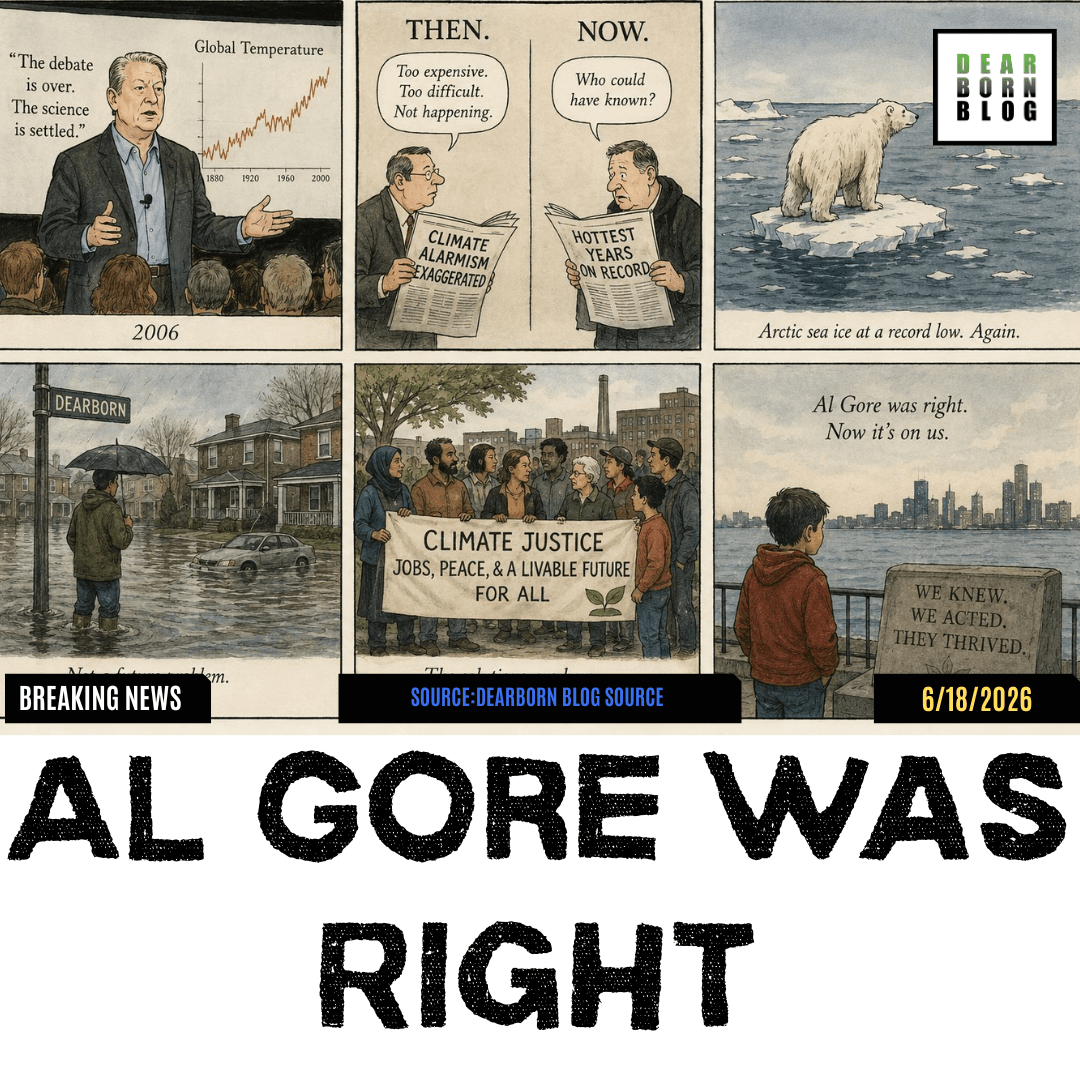
Twenty years after An Inconvenient Truth, the argument is no longer whether Al Gore was “alarmist.” The record shows the climate crisis he warned about is here: hotter years, rising seas, shrinking ice, heavier storms, and a political class still pretending physics can be filibustered. For Dearborn, this is not abstract. It is flooded basements, expensive infrastructure, unhealthy air, and a moral test of whether we build a livable future or keep subsidizing the fire.
Twenty Years Later, The Receipts Are In
When Al Gore’s An Inconvenient Truth reached the public in 2006, many people treated it as a political movie, not a scientific warning. Some mocked it because Gore was a Democrat. Some dismissed it because fossil fuel money had already spent decades teaching the public to confuse doubt with wisdom. Some watched the documentary, felt scared for a weekend, then went back to normal life because normal life is comfortable — until the water comes through the basement drain.
Now, twenty years later, the world does not need another debate about whether climate change is real. The world needs an honest accounting.
And that accounting is brutal.
The core message of An Inconvenient Truth was simple: human beings were loading the atmosphere with greenhouse gases, the planet was warming, ice was melting, seas were rising, weather extremes would become more dangerous, and the cost of delay would be far higher than the cost of action. That was not science fiction. It was science with a microphone. Gore did not invent the science; he popularized it. He gave charts and ice-core data a Hollywood release. For that, he became a punching bag.
But the planet does not care about cable-news sarcasm.
The planet kept warming.
According to NASA, the evidence for rapid climate change is “compelling,” including rising global temperatures, warming oceans, shrinking ice sheets, retreating glaciers, declining snow cover, sea-level rise, and more extreme events.[1] The Intergovernmental Panel on Climate Change has gone even further, stating that it is “unequivocal” that human influence has warmed the atmosphere, ocean, and land.[2] NOAA reported that 2025 ranked as the third-warmest year in the global record going back to 1850, behind only 2024 and 2023, and that the ten warmest years have all occurred since 2015.[3]
That is not a coincidence. That is a trend. And trends, unlike politicians, do not need consultants to tell them what they believe.
What Gore Got Right
The fairest way to judge An Inconvenient Truth is not to ask whether every image, estimate, or dramatic flourish aged perfectly. It is to ask whether the central warning held up.
It did.
Gore warned that carbon dioxide would keep rising unless humanity changed course. NOAA’s Mauna Loa Observatory recorded a monthly average of 432.34 parts per million of CO₂ in May 2026, compared with 430.51 ppm in May 2025.[4] The global monthly mean CO₂ in March 2026 was 428.60 ppm, up from 426.59 ppm in March 2025.[5] The line is still climbing. Humanity is still treating the atmosphere like a free landfill with premium consequences.
Gore warned that the planet would continue heating. NOAA’s 2025 climate assessment found that 2025 was 1.17°C above the 20th-century average and 1.34°C above the pre-industrial average.[3] The World Meteorological Organization confirmed that 2025 was among the warmest years on record, with different major datasets ranking it second or third.[6] That means the last two decades did not disprove Gore’s warning. They underlined it in permanent marker.
Gore warned that ice would retreat. NASA and the National Snow and Ice Data Center reported that Arctic winter sea ice in March 2026 tied the lowest peak observed since satellite monitoring began in 1979.[7] NSIDC also reported that the four Antarctic sea ice minimums from 2022 through 2025 were the four lowest in the 47-year satellite record.[8] Ice has natural ups and downs, but the long-term direction is not a mystery. The refrigerator door has been left open, and the adults in charge are still arguing about whether electricity exists.
Gore warned that water would become a frontline issue. NASA lists sea-level rise as one of the major lines of evidence for climate change.[1] Around the Great Lakes, the issue is not ocean tides but heavier precipitation, warmer water, reduced ice cover, erosion, flooding, and stressed infrastructure. The Great Lakes Integrated Sciences and Assessments program at the University of Michigan reports that annual precipitation in the U.S. Great Lakes region has increased by 14% since 1951, and that total annual precipitation will likely continue to increase.[9]
That lands close to home.
Dearborn Already Knows What Climate Delay Costs
For Dearborn, climate change is not an abstract graph. It is a sump pump. It is sewage in basements. It is insurance claims, missed work, ruined family photos, mold, stress, and a municipal budget forced to spend more because national leaders spent decades spending too little.
Dearborn experienced major flood events in 2014 and 2021. Reporting by Michigan Public noted that the 2021 flooding affected about two-thirds of Dearborn homes with sewage water in basements.[10] The city has since made flood prevention and stormwater management a major priority, including rain gardens and other mitigation projects in targeted flood areas.[11] Local reporting in 2025 found that Dearborn’s combined sewer and stormwater system manages about 3.5 inches of rainfall per day, leaving the city vulnerable to heavier storms.[12]
This is the local face of a global crisis.
People sometimes say, “Climate has always changed.” True. And people have always died, but that does not mean hospitals are a scam. The issue is not whether climate changes naturally. The issue is that human activity is now driving rapid warming, and our systems — roads, sewers, farms, power grids, housing, public health — were built for a climate that no longer exists.
Dearborn’s families do not need another lecture from fossil fuel lobbyists. They need infrastructure that can handle the rain that is actually falling, not the rain that engineers expected fifty years ago. They need clean air. They need lower energy bills. They need tree canopy, public transit, resilient homes, emergency planning, and political leadership that can say the words “climate crisis” without checking first whether donors approve.
The Politics Of Denial Were Never Free
One of the great tragedies of the last twenty years is that America had time. Not unlimited time, but real time. Time to build a renewable energy economy. Time to electrify public transit. Time to retrofit homes. Time to strengthen cities against flooding and heat. Time to stop treating climate policy as a culture-war accessory.
Instead, denial became a business model.
The fossil fuel industry protected profits. Politicians protected donors. Media outlets hosted fake debates between climate scientists and professional confusion merchants, as though atmospheric chemistry were a dinner-table opinion. The public was told that action would be too expensive, while the bill for inaction quietly grew in the background like interest on a payday loan from hell.
Now the bill is arriving.
The choice was never between “the economy” and “the environment.” That was always a rigged frame. The real choice is between an economy that serves life and an economy that burns the future to inflate quarterly earnings. A serious climate agenda means jobs, manufacturing, public works, lower household costs, healthier neighborhoods, and less dependence on oil markets shaped by war and empire.
That is why the Green Party’s platform has long connected ecology with democracy, social justice, peace, and economic rights.[13] Climate policy cannot be reduced to swapping gasoline cars for electric cars while leaving inequality untouched. A livable future requires a just transition: public investment, worker protections, community ownership, clean energy, public transit, regenerative agriculture, and a foreign policy that stops setting whole regions on fire while pretending to care about emissions.
Climate Justice Is Also Peace Justice
For a Dearborn audience, any serious climate conversation must include Palestine, the Middle East, and the Global South. Climate breakdown does not hit all people equally. The communities least responsible for historic emissions often face the harshest consequences: heat, drought, displacement, food insecurity, water scarcity, and war intensified by resource stress.
A pro-Palestine climate position is not a slogan pasted onto an environmental article. It is a recognition that land, water, freedom, and survival are inseparable. You cannot bomb farmland, destroy water infrastructure, uproot communities, and then talk about sustainability with a straight face. Environmental justice without human rights is just green branding. Human rights without ecological survival is a promise made on a sinking ship.
The same moral framework applies here in Dearborn. Low-income neighborhoods, immigrants, elders, renters, disabled residents, and families living near industrial corridors often carry heavier environmental burdens. Climate justice means those communities should not be last in line for protection and first in line for pollution.
Al Gore’s documentary helped mainstream the climate conversation, but the next step must go beyond awareness. Awareness is not enough when the basement is flooding. Awareness is not enough when asthma rates rise. Awareness is not enough when children inherit a hotter, harsher planet while billionaires sell “resilience” as a luxury product.
The next step is power.
What Needs To Happen Now
The lesson of the last twenty years is not that one documentary could save the world. No film can do that. The lesson is that warnings matter only if people organize around them.
Dearborn and cities like it should push for climate action at every level:
First, flood protection must become a permanent infrastructure priority, not a panic response after each disaster. That includes sewer upgrades, green infrastructure, rain gardens, permeable surfaces, tree planting, and honest public reporting about neighborhood vulnerability.
Second, energy policy must be treated as household economic policy. Weatherization, efficient appliances, rooftop and community solar, and electrification can lower bills and reduce pollution, but only if programs are designed for working families, renters, seniors, and small businesses — not just homeowners with spare cash.
Third, public transit and walkable neighborhoods must be part of climate policy. A city where every errand requires a car is not freedom; it is an invoice on wheels. Better transit means cleaner air, lower costs, more independence for youth and elders, and fewer emissions.
Fourth, schools, mosques, churches, unions, small businesses, and civic groups should become climate resilience hubs. During floods, heat waves, outages, and emergencies, people trust local institutions. Those institutions should have plans, resources, communication networks, and public support.
Fifth, climate action must reject militarism and endless war. A society cannot claim to defend the future while pouring public wealth into destruction. The same imagination that can fund bombs overnight can fund solar panels, clean water systems, hospitals, and flood protection — if we force it to.
The Critics Were Loud. The Data Was Louder.
To be balanced, not every claim associated with An Inconvenient Truth should be treated as perfect prophecy. Climate science deals in probabilities, ranges, feedback loops, and timelines. Some impacts arrive faster than expected; some slower; some differently by region. Critics have pointed to specific moments in the film they believe were overstated or simplified. Fine. Public science communication can always be debated.
But the larger verdict is clear: Gore’s central warning was right.
The warming is real. Human activity is the dominant cause. CO₂ is still rising. The hottest years are piling up in the present, not hiding in some distant future. Ice is retreating. Seas are rising. Heavy rainfall is stressing cities. The Great Lakes region is already changing. Dearborn has already paid part of the price.
The people who mocked the warning should not be allowed to quietly rebrand themselves as “realists.” Realism means looking at the evidence and acting accordingly. Denial wrapped in confidence is still denial.
And delay is still denial with better manners.
Dearborn’s Voice In A Hotter World
Dearborn has a special role to play because Dearborn understands the intersection of local survival and global justice. This city knows what it means to be stereotyped, ignored, extracted from, and lectured by people who do not live with the consequences of their policies. That experience can become political wisdom.
A Dearborn climate voice should say: protect working families, not corporate polluters. Fund flood prevention before disaster. Build clean-energy jobs with union wages. Stand with Palestine and all communities fighting for land, water, and dignity. Reject the false choice between environmental justice and economic justice. Demand peace because war is ecological violence. Demand democracy because the planet cannot be saved by the same donor class that profited from endangering it.
Twenty years after An Inconvenient Truth, Al Gore does not need a victory lap. The rest of us need a rescue plan.
The inconvenient truth is no longer hidden. It is in the heat records, the sea ice charts, the CO₂ readings, the flooded streets, and the insurance bills. It is in the Great Lakes. It is in Dearborn basements. It is in the lungs of children living near pollution. It is in every government budget that chooses reaction over prevention.
Al Gore was right enough that history should stop laughing at the warning and start indicting the delay.
Now the question is whether we will be right in time.
Source List
[1] NASA Science — “Evidence: The Evidence for Rapid Climate Change Is Compelling.” NASA summarizes multiple observed indicators of climate change, including rising global temperature, ocean warming, shrinking ice sheets, glacier retreat, declining snow cover, sea-level rise, and extreme events.
[2] Intergovernmental Panel on Climate Change — AR6 Working Group I, Summary for Policymakers Headline Statements. The IPCC states that human influence has warmed the atmosphere, ocean, and land, and that widespread rapid changes have occurred across the climate system.
[3] NOAA National Centers for Environmental Information — “Annual 2025 Global Climate Report.” NOAA reports that 2025 ranked as the third-warmest year since records began in 1850, behind 2024 and 2023, and that the ten warmest years have all occurred since 2015.
[4] NOAA Global Monitoring Laboratory — “Trends in CO₂, Mauna Loa.” NOAA reports Mauna Loa monthly average CO₂ at 432.34 ppm in May 2026 and 430.51 ppm in May 2025.
[5] NOAA Global Monitoring Laboratory — “Trends in Atmospheric Carbon Dioxide, Global Monthly Mean CO₂.” NOAA reports global monthly mean CO₂ at 428.60 ppm in March 2026 and 426.59 ppm in March 2025.
[6] World Meteorological Organization — “WMO confirms 2025 was one of warmest years on record.” WMO summarizes multiple international datasets ranking 2025 among the warmest years on record.
[7] NASA Science — “Arctic Winter Sea Ice Ties Record Low, NASA, NSIDC.” NASA reports that Arctic winter sea ice in March 2026 tied the lowest peak observed in the satellite record.
[8] National Snow and Ice Data Center — “Antarctic sea ice minimum hits a near-record low, again.” NSIDC reports that the Antarctic sea ice minimums of 2022, 2023, 2024, and 2025 were the four lowest in the 47-year satellite record.
[9] Great Lakes Integrated Sciences and Assessments, University of Michigan — “Climate Impacts.” GLISA reports that annual precipitation in the U.S. Great Lakes region has increased 14% since 1951 and is likely to continue increasing.
[10] Michigan Public / Planet Detroit — “Dearborn is taking aggressive new measures to avoid flooding. Is it enough?” The article reports Dearborn’s major 2014 and 2021 flood events and notes that about two-thirds of Dearborn homes experienced sewage water in basements during the 2021 event.
[11] City of Dearborn — “Flood Preparedness & Recovery.” The city describes flood recovery efforts, including planned rain garden demonstration projects in targeted heavy flooding areas.
[12] WDIV ClickOnDetroit — “How Dearborn is improving stormwater systems to prevent future floods.” The report states Dearborn’s combined sewer and stormwater system manages about 3.5 inches of rainfall per day and describes long-term flood mitigation planning.
[13] Green Party of the United States — “Platform.” The Green Party platform links ecological sustainability with grassroots democracy, social justice, nonviolence, and future generations.
Disclaimer
This article is commentary and analysis based on publicly available scientific, governmental, journalistic, and policy sources. Dearborn Blog does not claim that any single weather event is caused solely by climate change unless specifically established by attribution science. Climate science involves ranges, probabilities, and evolving evidence. Readers should consult original sources, qualified experts, and local authorities for technical, legal, public health, infrastructure, or emergency guidance. This article reflects an editorial perspective in support of environmental justice, peace, democracy, and community resilience.


