

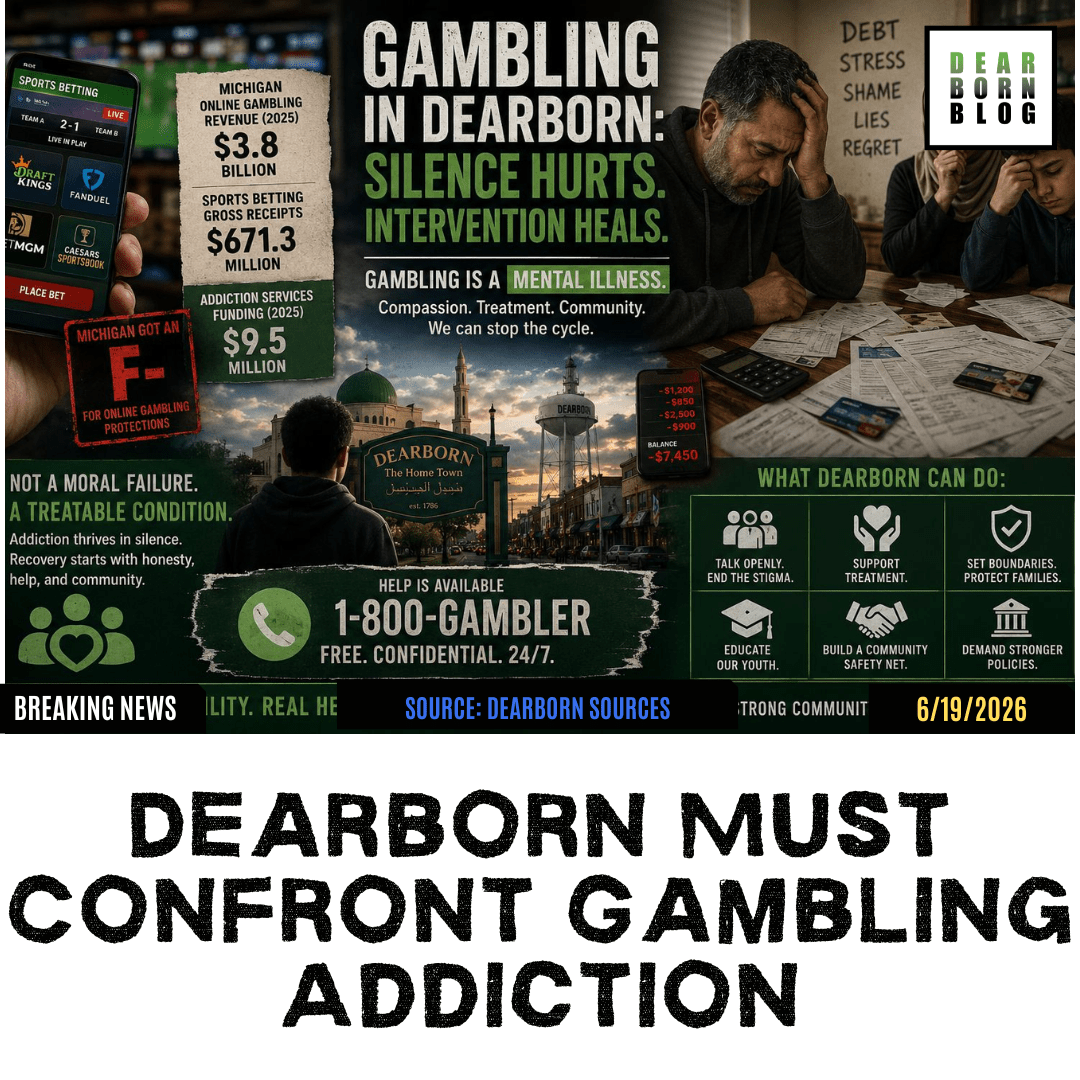
Online gambling has moved from casino floors to kitchen tables, phones, bedrooms, barber shops, coffee shops, and school hallways. In Dearborn, where family reputation and community image often keep pain hidden, gambling disorder must be treated as what it is: a mental health condition, not a moral failure. The city needs a compassionate intervention before more families are drained in silence.
There is a quiet crisis moving through Michigan, and Dearborn is not immune. It does not always smell like alcohol. It does not always leave visible bruises. It does not always end with flashing police lights or a public scandal. Sometimes it looks like a father staring at his phone after midnight. Sometimes it looks like a son chasing one more parlay before rent is due. Sometimes it looks like a mother quietly discovering that savings meant for tuition, a wedding, a home repair, or a family emergency have disappeared into a betting app.
Gambling addiction is not a joke. It is not “just bad discipline.” It is not simply a person being greedy, irresponsible, or weak. Gambling disorder is a recognized mental health condition, a behavioral addiction that can destroy families, finances, marriages, careers, and self-respect when it is left untreated.[1] In a community like Dearborn, where pride, faith, family honor, and public image matter deeply, the tragedy is doubled: people suffer from the addiction, and then they suffer again from the shame of admitting it.
Michigan helped create the conditions for this crisis. Legalized online gambling and sports betting have made the casino pocket-sized. What once required a drive to a gaming floor now requires only a phone, a bank card, and a moment of loneliness, stress, or false confidence. The old casino had doors, distance, parking lots, and social visibility. The new casino has push notifications.
According to reporting by Bridge Michigan, Michigan pulled in $624.6 million from online gambling last year, including $27.1 million in taxes and fees from sports betting. Yet the state allocated only $9.5 million this year toward gambling addiction services.[2] That mismatch tells its own story. The machine is well-funded. The safety net is not.
And the machine is growing. Michigan online gambling produced $3.8 billion in 2025, including $671.3 million in online sports betting gross receipts, according to state records cited by Bridge Michigan.[3] This is no longer a side issue. It is an industry with bright lights, celebrity endorsements, fantasy-sports language, and carefully designed apps that make losing money feel like entertainment until the bank account, the credit cards, and the family trust are gone.
Dearborn is a city of families, mosques, churches, small businesses, immigrant sacrifice, working-class pride, and political consciousness. It is also a city where many people are trained from childhood to protect the family name at almost any cost. That instinct can be beautiful when it means loyalty. It becomes dangerous when it means silence.
In many Arab, Muslim, immigrant, and working-class households, mental illness is still too often treated as something to hide rather than something to heal. A person struggling with anxiety may be told to pray more. A person with depression may be told to be grateful. A person with addiction may be called selfish. Prayer matters. Gratitude matters. Personal responsibility matters. But none of these replaces treatment, community support, and honest intervention.
The stigma around gambling is especially intense because gambling collides with religious values, cultural expectations, and family economics. Many families do not know how to talk about it without turning immediately to anger, blame, or humiliation. So the gambler hides. The spouse hides. The parents hide. The siblings hide. Everyone becomes an unpaid public relations department for a crisis that is eating the house from the inside.
Dearborn cannot afford this silence. A city that knows how to mobilize for Palestine, labor rights, immigrant dignity, anti-racism, and social justice must also learn how to mobilize for mental health inside its own homes. Justice abroad and denial at home cannot live in the same moral house forever.
A balanced conversation must be clear: not everyone who buys a lottery ticket, plays cards, visits a casino, or places a sports bet has gambling disorder. The issue is not whether every form of risk is the same. The issue is when gambling becomes compulsive, secretive, destructive, and uncontrollable.
The American Psychiatric Association describes gambling disorder as repeated betting that continues despite causing serious problems in a person’s life.[5] The warning signs include chasing losses, lying about gambling, risking relationships or jobs, borrowing money, feeling restless when trying to stop, and returning again and again after promising “never again.”
That last phrase — “never again” — is important. Families often misunderstand addiction because they focus only on the promise. “He promised.” “She swore.” “They cried and said they were done.” But addiction is not defeated by a dramatic apology. Recovery requires structure: treatment, blocking tools, financial boundaries, accountability, peer support, and a family that stops confusing secrecy with mercy.
There is no virtue in enabling someone to keep drowning because we are too embarrassed to throw a rope.
Bridge Michigan’s reporting captured the central danger of online betting: it is “readily available” and “limitless,” as Karley Abramson of the Citizens Research Council of Michigan put it.[6] That is not a small design feature. That is the business model.
A casino on a phone removes friction. It removes time. It removes witnesses. It removes the social pause that might once have stopped someone from making another desperate bet. The gambler no longer has to walk past security, drive home, or face the cold air outside. The next bet is right there, glowing in the dark.
This is especially dangerous for young people. Sports betting has been normalized through advertising, podcasts, influencer culture, fantasy sports, and group chats. It is sold as knowledge, masculinity, strategy, and fun. But the house is not a charity, and the app is not your cousin giving friendly advice. The algorithm knows more about your weakness than your imam, priest, therapist, or best friend might know.
Michigan has begun some youth-focused prevention work. In May 2026, the Michigan Gaming Control Board launched “Don’t Bet on Your Future,” a statewide campaign aimed at protecting young people from underage and problem gambling.[7] That is a start. But Dearborn should not wait for Lansing to solve a problem already sitting in our living rooms.
The financial damage can be catastrophic. Bridge Michigan reported examples from bankruptcy attorneys, including a client with nearly $200,000 in debt from online sports betting and another person wagering $20,000 on single football games.[8] Those numbers may sound extreme, but addiction specializes in turning “never me” into “how did this happen?”
The pattern is familiar: savings first, then credit cards, then loans, then borrowing from relatives, then lying, then panic, then one desperate attempt to win everything back. The gambler says, “I just need one big hit.” But the big hit is often just bait for the next loss. A parlay win becomes a testimony. The losses become classified documents.
Families often discover the crisis late because the person gambling has become skilled at concealment. They may hide bank statements, open new accounts, borrow quietly, sell items, delay bills, or use business money. By the time relatives intervene, the financial hole is not just a hole. It is a tunnel system.
But the emotional debt can be worse. Trust collapses. Spouses feel betrayed. Parents feel ashamed. Children feel unsafe. Siblings become investigators. Friends become lenders and then former friends. The person with gambling disorder may sink into depression, self-hatred, panic, and isolation. This is where Dearborn must speak with compassion and urgency: addiction can become deadly when shame convinces a person that there is no way back.
A serious response should be rooted in public health, not punishment alone. That is where a Green Party lens is useful: people should not be sacrificed to corporate profit, communities should not be left to clean up private industry’s damage, and prevention should be funded before crisis becomes catastrophe.
Online gambling companies make money from volume, frequency, and repeat behavior. Their profits rise when people keep betting. A justice-centered policy must ask a basic question: if the state and operators collect revenue from gambling, why is treatment and prevention still underfunded? Public money should protect the public, not merely decorate state budgets after harm has already been extracted.
Michigan should ban credit card funding of gambling accounts, require stronger affordability checks, restrict predatory advertising, prohibit targeted marketing to young people and vulnerable users, require meaningful cooling-off periods after major losses, and limit algorithmic personalization that feeds customized bets to people based on their betting history. These are not radical ideas. They are seatbelts. Only the gambling lobby thinks seatbelts are oppression.
State Sen. Erika Geiss of Taylor introduced legislation to regulate gambling and sports betting advertisements, including restrictions meant to protect people under 21.[9] The Citizens Research Council of Michigan has also recommended policy changes such as barring prop bets and limiting the use of algorithms to customize betting offers.[10] These proposals deserve serious attention, especially from communities like Dearborn that understand how corporate power often targets working people while calling it “choice.”
Dearborn needs a community intervention model. Not a one-day lecture. Not a shame campaign. Not a sermon that leaves people more afraid to speak. We need a coordinated public health response that includes families, schools, mosques, churches, doctors, therapists, social workers, youth mentors, business owners, and city leaders.
First, every major community institution should normalize the sentence: “Gambling disorder is treatable.” That sentence should be said in Arabic and English, in Friday reminders, Sunday announcements, school workshops, youth programs, and family health events. It should be repeated until it becomes boring — because boring public health messages save lives.
Second, Dearborn should create confidential referral pathways. A person who admits gambling addiction should know exactly where to call, who to meet, and how to begin without being publicly exposed. Confidentiality is not a luxury in a stigma-heavy community. It is the bridge between suffering and help.
Third, local organizations should offer family education. Families need to learn the difference between support and enabling. Paying off gambling debt without treatment can become fuel for the next disaster. Screaming without a plan can make the person disappear further into secrecy. The family needs boundaries: no secret loans, no unlocked access to shared money, no pretending, and no public humiliation.
Fourth, every household dealing with gambling disorder should consider practical barriers: self-exclusion programs, gambling-blocking software, financial controls, debt counseling, therapy, and peer-support groups. The Michigan Gaming Control Board offers self-exclusion options through the Responsible Gaming Database for online gambling and the Disassociated Persons List for Detroit casinos.[11] Michigan residents can also access free gambling-blocking software through the state’s partnership with Gamban.[12]
Fifth, Dearborn schools and youth programs should treat sports betting like vaping: not as an adult issue that magically begins at 21, but as a youth exposure issue that begins with ads, jokes, group chats, and social pressure. Prevention has to arrive before the first crisis.
In Dearborn, faith communities are essential. But religious language must be used carefully. Telling people that gambling is spiritually harmful may be true within many traditions, but if the message stops there, it may deepen shame without creating recovery. The better message is stronger: your faith calls you back to life, and treatment is one of the doors back.
Mosques and churches should not become places where people hide their wounds behind perfect public behavior. They should be places where repentance includes repair, where families are guided toward professional help, and where addiction is addressed without turning the struggling person into a permanent disgrace.
There is also a special responsibility for men in the community. Gambling addiction is often wrapped in masculine pride: the big win, the sports knowledge, the hustle, the secret confidence that “I can fix it.” Many men are trained to confess nothing until everything collapses. Dearborn needs men who can say to other men: asking for help is not weakness. Losing your family because of pride is weakness.
Anyone in Michigan who is struggling with gambling can call the Michigan Problem Gambling Helpline at 1-800-GAMBLER. Help is available 24/7, free and confidential.[13] People can also seek support through Gamblers Anonymous, Gam-Anon for loved ones, licensed therapists, financial counselors, and primary care doctors who can help connect them to treatment.
Treatment works. Cognitive behavioral therapy and other evidence-based approaches can reduce gambling harm and help people rebuild control.[14] Recovery is not easy, but it is real. Families can heal. Debt can be addressed. Trust can be rebuilt slowly. The first step is ending the lie that this is only a private shame.
Dearborn is often discussed nationally through politics, identity, Palestine, elections, immigration, and culture-war headlines. But the real Dearborn is also measured in quieter places: at the kitchen table, in the family business, in the mosque office, in the school counselor’s room, in the spouse who finally says, “We need help,” and in the friend who refuses to lend more money but offers to drive someone to treatment.
A pro-Palestine, pro-justice, pro-worker community cannot ignore addiction because it is uncomfortable. Liberation is not only a slogan for people far away. It is also the work of freeing our own families from silence, debt, shame, and industries that profit from despair.
The house always wins when the community stays silent. Dearborn does not have to stay silent.
We can choose intervention over gossip. Treatment over shame. Prevention over profit. Public health over private ruin. And, most importantly, we can choose to see the person struggling with gambling disorder not as a disgrace to be buried, but as a human being who needs accountability, help, and a way home.
This article is for public education and community discussion only. It is not medical, psychiatric, legal, financial, or religious advice. Gambling disorder and related mental health concerns should be addressed with qualified professionals, including licensed mental health providers, physicians, certified addiction counselors, financial counselors, and legal professionals where appropriate. If you or someone you know may be struggling with gambling addiction in Michigan, call 1-800-GAMBLER for free, confidential help available 24/7. If there is an immediate danger of self-harm or harm to others, call 911 or contact emergency services immediately.

 Dearborn Blog