

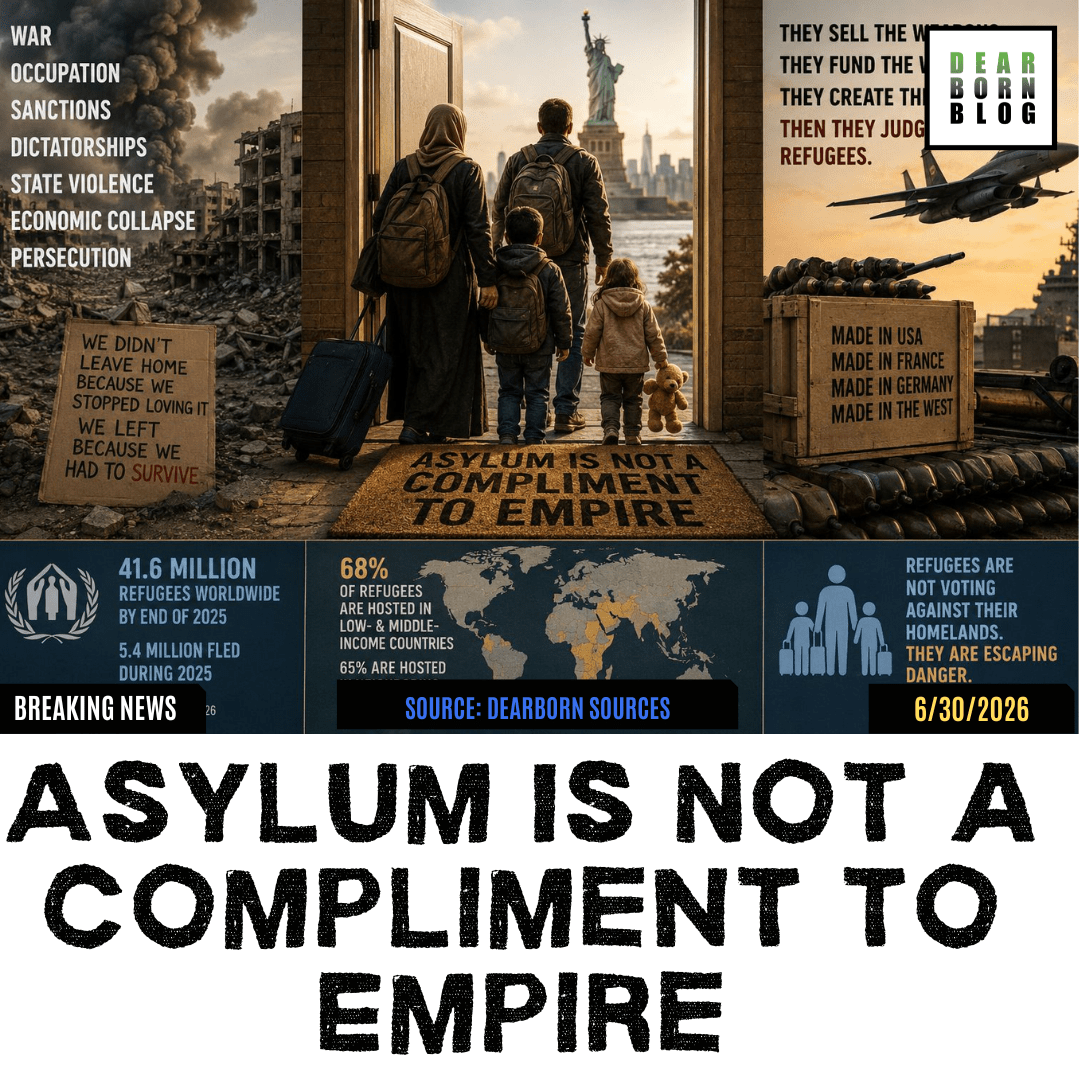
Excerpt: Refugees do not flee because they stopped loving home. They flee because survival became impossible. When powerful countries help create war, occupation, sanctions, arms flows, and instability, asylum is not proof of Western superiority. It is often evidence of Western responsibility.
There is a cruel little argument that keeps showing up whenever refugees, immigrants, Arabs, Muslims, Palestinians, Africans, or people from the Global South criticize Western foreign policy: “If your country is so great, why did you come here?”
It sounds sharp to people who confuse sarcasm with intelligence. But the argument collapses the moment it meets reality.
A refugee choosing a Western country for asylum is not making a philosophical statement that the West is better than their homeland. Most of the time, they are making a survival decision. They are not choosing between “civilizations.” They are choosing between life and death, prison and safety, hunger and food, bombardment and a roof, statelessness and paperwork, fear and one more sunrise.
UNHCR defines refugees as people who have fled their countries to escape conflict, violence, or persecution and sought safety in another country.[1] That definition matters because it begins with force. Refugees are not tourists with dramatic paperwork. They are people pushed out by conditions no human being should have to endure.
People do not flee because they suddenly stopped loving their language, food, family, land, culture, history, or faith. Palestinians do not stop loving Palestine when they seek safety in Europe. Syrians do not stop loving Syria when they apply for asylum in Germany. Yemenis, Iraqis, Afghans, Lebanese, Sudanese, Congolese, Somalis, or Haitians do not abandon the souls of their homelands because they cross a border. They flee because normal life was made impossible by war, occupation, dictatorship, sanctions, economic collapse, persecution, state violence, or climate disasters intensified by global inequality.
In other words: asylum is not a compliment to empire. Often, it is an indictment of empire.
A person running from a burning house into the neighbor’s house is not declaring the neighbor’s house more beautiful. And if the neighbor helped start the fire, opening the door is not charity. It is the bare minimum of responsibility.
The Numbers Tell a Different Story
The first myth to destroy is that “everyone is coming to the West.” They are not.
UNHCR reported that by the end of 2025, there were 41.6 million refugees worldwide, and 5.4 million people were forced to flee and seek safety in another country during that year.[2] But the idea that refugees are mainly “flooding” rich Western countries is politically useful fiction. UNHCR says that at the end of 2025, 65 percent of refugees were hosted in neighboring countries, and 68 percent were hosted in low- and middle-income countries.[3]
Reality check: Most refugees do not reach wealthy Western countries. Most remain close to home, often in countries with far fewer resources than the United States or Europe.
This is not a small detail. It demolishes the lazy claim that refugees are “voting with their feet” for Western moral superiority. If refugees were simply choosing the “best civilization,” most would head straight to the richest countries. Instead, most remain in neighboring countries because proximity, family ties, language, borders, geography, money, legal access, and emergency survival matter more than ideological symbolism.
Syrians are a clear example. By the end of 2024, UNHCR-related data showed 6.1 million Syrian refugees and asylum-seekers, with another 7.4 million internally displaced. Nearly 80 percent of Syrian refugees were hosted in neighboring countries, including Türkiye, Lebanon, and Jordan.[4] That is not because every Syrian suddenly decided Türkiye, Lebanon, or Jordan were “better” than Syria. It is because they were reachable when Syria became unlivable.
The same logic applies to Palestinians. UNRWA serves Palestine refugees across Jordan, Lebanon, Syria, Gaza, and the West Bank. More than 1.5 million Palestine refugees live in 58 recognized refugee camps.[5] Jordan alone hosts more than 2.39 million registered Palestine refugees, the largest number in UNRWA’s fields.[6] A Palestinian in Jordan or Lebanon is not making a judgment that exile is superior to Haifa, Yaffa, Jerusalem, Gaza, Nablus, or Ramallah. Exile is not a love letter. It is a wound with paperwork.
Why People Flee: Fire, Not Philosophy
There is something morally obscene about asking refugees to defend their love for home while they are still carrying the trauma of losing it.
Ask any refugee what they miss and the answer will not sound like a political science lecture. It will be the smell of coffee in a mother’s kitchen. A street corner. A school. A mosque. A church. A grandmother’s accent. A mountain. A sea. A fig tree. A cemetery where ancestors are buried. A home they may never see again.
Refugees are not rejecting home. They are rejecting death. They are rejecting prison. They are rejecting the barrel bomb, the drone strike, the checkpoint, the militia, the torture chamber, the starvation siege, the collapsing currency, the occupation permit system, the armed gang, the forced conscription, the death squad, the ethnic cleansing campaign, or the warlord with foreign weapons.
That is the difference between migration as opportunity and asylum as necessity. Yes, many people move for education, work, marriage, or economic advancement. But refugees and asylum seekers are legally and morally distinct because danger is central to their movement. They flee because staying may cost them their freedom, dignity, or life.
Refugees are not voting against their homelands. They are escaping danger. Survival has no luxury of symbolism.
The Part Western Critics Leave Out
Here is the part many Western critics conveniently leave out: many of the wealthy countries refugees seek safety in are also deeply involved in producing the conditions that created those refugees in the first place.
They manufacture the weapons. They arm allies. They support occupations. They protect dictatorships. They sanction economies. They veto accountability. They profit from instability, then act surprised when the victims of that instability arrive at their borders.
SIPRI’s 2025 report on international arms transfers found that the United States was by far the largest exporter of major arms in 2020–2024, accounting for 43 percent of global arms exports. France ranked second with 9.6 percent, while Germany remained among the top five exporters.[7] This is not an abstract statistic. Weapons are not decorative objects. They land somewhere. They empower someone. They shape battlefields, occupations, sieges, police states, and proxy wars.
Amnesty International has warned that irresponsible arms transfers have a direct connection to human rights abuses, including serious violations of international humanitarian law and possible war crimes.[8] Amnesty also says governments have continued to flout Arms Trade Treaty rules, enabling transfers that facilitate grave abuses and devastating loss of life in conflict zones.[9]
So when refugees from war-torn regions arrive in the same countries whose defense industries, alliances, intelligence operations, sanctions regimes, or diplomatic shields helped sustain violence, the question should not be, “Why are you here?” The question should be, “What did our governments do there?”
That question is not anti-American. It is pro-accountability. It is also deeply consistent with the Green Party platform’s emphasis on peace, demilitarization, human rights, international law, and redirecting resources from militarism toward human needs. A society cannot bomb, sanction, arm, destabilize, and then pretend asylum is an act of charity detached from foreign policy.
Iraq: The Refugee Crisis After “Liberation”
Iraq is one of the clearest examples of how Western war produces displacement, then Western politics punishes the displaced.
The U.S.-led invasion of Iraq began on March 20, 2003. Twenty years later, the Center for Strategic and International Studies noted that the invasion and occupation cost an estimated half million Iraqi lives, caused at least 9.2 million people to be displaced, and left millions facing food insecurity.[10] That is not a minor footnote in history. That is a national catastrophe.
When Iraqis fled to Syria, Jordan, Europe, the United States, Canada, Australia, or elsewhere, they were not saying Baghdad, Mosul, Basra, Najaf, Karbala, Fallujah, or Erbil were unworthy of love. They were fleeing a country shattered by invasion, occupation, sectarian violence, terrorism, sanctions, corruption, and state collapse.
To ask an Iraqi refugee, “If Iraq is so great, why did you leave?” is like asking someone why they jumped out of a car after someone else cut the brakes. The answer is not complicated. The car was made unsafe.
Syria: Refugees Did Not Choose Exile Over Home
Syria’s refugee crisis is another moral test the world keeps failing.
Syrians fled dictatorship, torture, bombardment, extremist violence, foreign intervention, economic collapse, sanctions, and a war that turned cities into graveyards. By the end of 2024, there were 6.1 million Syrian refugees and asylum-seekers and 7.4 million internally displaced Syrians.[4] Most Syrian refugees did not reach Western Europe. They stayed in the region, especially Türkiye, Lebanon, and Jordan.[4]
Germany did receive a significant number of Syrians, and many rebuilt their lives there. But that does not mean Germany replaced Syria in their hearts. It means Germany, for many, became legally reachable and safer at a moment when home was not.
And when conditions shift, people often return despite hardship. Reuters reported in June 2026 that UNHCR said global displacement declined in 2025 for the first time in a decade, partly because millions returned home, including Syrians after major political changes in Syria. But UNHCR also warned that many returns occurred under harsh conditions, with limited services and continued insecurity.[11] That tells us something profound: refugees often want to go home even when home is broken. Exile is rarely the dream. It is the emergency room.
Yemen: Weapons In, Refugees Out
Yemen shows the deadly connection between arms exports, foreign alliances, and civilian suffering.
The war in Yemen has involved regional and international actors, including the Saudi-led coalition and weapons supplied by Western governments. PBS NewsHour reported on an Oxfam finding that weapons supplied by the United Kingdom and United States and used by the Saudi-led coalition killed at least 87 civilians and wounded 136 in attacks between January 2021 and February 2022.[12] Human Rights Watch had earlier called for an arms embargo on Saudi Arabia, citing coalition airstrikes and the humanitarian crisis caused by the war and blockade.[13]
So when a Yemeni family seeks safety abroad, what exactly are they supposed to be “proving”? That London is morally better than Sana’a? That Washington is more beloved than Aden? No. They are proving that bombs, blockades, hunger, and state collapse force people into impossible choices.
Again: asylum is not applause. It is evidence.
Palestine: Exile Is Not Consent
Palestinians understand this argument in their bones.
For more than seven decades, Palestinians have lived with dispossession, occupation, refugeehood, siege, apartheid conditions, settlement expansion, military rule, home demolitions, family separation, and repeated bombardment. When Palestinians seek refuge, they are not saying Europe, Canada, or America is more sacred than Palestine. They are saying the world helped deny them safety at home.
U.S. policy is central to this. The Council on Foreign Relations, drawing from official figures, notes that Israel has been the largest cumulative recipient of U.S. foreign aid since its founding, receiving more than $300 billion in total economic and military assistance when adjusted for inflation.[14] Brown University’s Costs of War project reported that the United States provided at least $21.7 billion in military aid to Israel from October 7, 2023 through September 2025.[15]
Human Rights Watch has urged key allies to suspend arms transfers to Israel and Palestinian armed groups where there is a real risk they could be used to commit grave abuses.[16] Amnesty International has also called on states to stop arms transfers to parties in Gaza, warning of complicity risks in war crimes and other violations of international law.[17] Meanwhile, the United States repeatedly used its veto power at the UN Security Council to block Gaza ceasefire resolutions, including a June 2025 resolution supported by the other 14 Council members.[18]
That is why the “Why did you come here?” argument is especially grotesque when aimed at Palestinians. If a Palestinian is forced into exile, the correct response is not smug nationalism. It is accountability for the governments that armed, funded, justified, excused, or diplomatically protected the machinery that helped make exile necessary.
Because your country helped set mine on fire, and now I am knocking on the door of the house that sold the gasoline, the matches, and the insurance policy.
The Host Country May Be Safer. That Does Not Make It Innocent.
There is a difference between a country being safer and a country being morally superior.
The United States is safer than many war zones. Germany is safer than many collapsed states. Canada may offer more legal protection than a dictatorship. France may have stronger infrastructure than a country under sanctions. Britain may have courts, universities, hospitals, and employment opportunities unavailable to someone whose homeland was bombed, occupied, destabilized, or economically strangled.
But safety is not innocence. Wealth is not innocence. Stability is not innocence. A mansion built partly from stolen lumber does not become morally pure because it has central heating.
Many Western countries are stable partly because they sit at the top of a global order that extracts resources, controls financial systems, dominates military alliances, sells weapons, shapes trade rules, and protects friendly regimes regardless of human rights records. Refugees often move toward places with functioning legal systems and economies because those places have accumulated power. The question is how that power was accumulated, and how it has been used.
This does not mean every Western citizen is personally responsible for every war. It means democratic societies have a responsibility to understand what is done in their name, with their tax dollars, by their elected officials, through their military alliances, and by corporations headquartered under their flags.
Dearborn Knows This Story
Dearborn knows this story because Dearborn is built from it.
Our city carries the memories of villages, refugee camps, border crossings, wars, sanctions, occupations, family separations, and impossible departures. Dearborn families know what it means to love a homeland from thousands of miles away. They know what it means to speak Arabic at home, English at work, and grief in silence. They know what it means to be told to “go back” by people who have never asked why going back is not always safe, legal, or possible.
But Dearborn also knows something else: refugees and immigrants do not weaken a community. They deepen it. They bring memory, resilience, entrepreneurship, faith, food, poetry, labor, political consciousness, and moral clarity. They remind America that foreign policy is not a video game. Every bomb has a destination. Every sanction has a stomach on the other end. Every veto has a child under rubble waiting for the world to stop debating language and start saving lives.
That is why Dearborn’s voice matters. We are not just another suburb on a map. We are a living archive of what empire calls “collateral damage.” We are also proof that people who survived displacement can build, lead, teach, heal, organize, and demand better from the country they now call home.
And demanding better is not hypocrisy. It is citizenship. It is conscience. It is exactly what a democratic society should welcome.
Stop Asking Refugees to Prove Gratitude
Refugees do not owe silence in exchange for safety.
They can be grateful for shelter and still criticize the foreign policy that helped destroy their shelter back home. They can appreciate legal protection and still condemn weapons sales. They can love America and still oppose American wars. They can become citizens and still speak for Palestine, Yemen, Iraq, Syria, Lebanon, Sudan, Congo, Afghanistan, or any other place where human beings are crushed by the machinery of power.
In fact, those who have lived the consequences of empire may be among the most qualified to criticize it. They are not speaking from theory. They are speaking from funerals, checkpoints, hunger, rubble, and exile.
So no: refugees choosing asylum in the West does not prove Western superiority. It proves that survival has no luxury of symbolism. Refugees are not voting against their homelands. They are escaping danger — often danger connected to the foreign policies, weapons, occupations, sanctions, and alliances of the very countries now judging them at the border.
The moral test is not whether refugees can prove enough gratitude to satisfy the comfortable. The moral test is whether powerful countries can stop producing refugees, stop arming destruction, stop protecting occupation, stop punishing civilian populations, and start treating asylum not as charity, but as responsibility.
Because when the house is burning, the first duty is to save the people inside. The second duty is to investigate who lit the match. And the third duty — the one too many empires fear — is to make sure they never get to call themselves firefighters while selling gasoline on the side.
Sources
[1] UNHCR, “Refugees,” defining refugees as people who flee conflict, violence, or persecution and seek safety in another country.
[2] UNHCR, “Global Trends,” 2026 release, reporting 41.6 million refugees at the end of 2025 and 5.4 million people forced to flee and seek safety in other countries during 2025.
[3] UNHCR, “Global Trends,” reporting that 65 percent of refugees were hosted in neighboring countries and 68 percent in low- and middle-income countries at the end of 2025.
[4] USA for UNHCR, “Refugee Statistics,” reporting Syrian refugee and internal displacement figures and the share hosted in neighboring countries.
[5] UNRWA, “Palestine Refugees,” reporting that more than 1.5 million registered Palestine refugees live in 58 recognized camps.
[6] UNRWA, “Where We Work: Jordan,” reporting more than 2.39 million registered Palestine refugees in Jordan.
[7] SIPRI, “Trends in International Arms Transfers, 2024,” reporting the United States as the largest exporter of major arms in 2020–2024 with 43 percent of global arms exports, with France and Germany among top exporters.
[8] Amnesty International, “Arms Control,” explaining the direct link between irresponsible arms trade and human rights violations.
[9] Amnesty International, “Governments’ brazen flouting of Arms Trade Treaty rules leading to devastating loss of life,” August 19, 2024.
[10] Center for Strategic and International Studies, “Iraq 20 Years After the Invasion,” March 20, 2023, discussing deaths, displacement, and food insecurity after the U.S.-led invasion.
[11] Reuters, “UNHCR says fewer people displaced worldwide in 2025 but long-term refugee crisis persists,” June 11, 2026.
[12] PBS NewsHour, “Arms supplied by UK, U.S. killed civilians in Yemen, report says,” January 11, 2023.
[13] Human Rights Watch, “Yemen: Embargo Arms to Saudi Arabia,” March 21, 2016.
[14] Council on Foreign Relations, “U.S. Aid to Israel in Four Charts,” October 7, 2025.
[15] Brown University Costs of War / Quincy Institute, “U.S. Military Aid and Arms Transfers to Israel, October 2023–September 2025,” reporting at least $21.7 billion in U.S. military aid to Israel since October 7, 2023.
[16] Human Rights Watch, “Suspend Arms to Israel, Palestinian Armed Groups,” November 6, 2023.
[17] Amnesty International, “Israel/OPT: Global Day of Action to demand states stop sending arms,” May 2, 2024.
[18] Reuters, “U.S. vetoes UN Security Council demand for Gaza ceasefire,” June 2025.
Disclaimer
This article is an opinion and analysis piece based on publicly available sources, humanitarian data, and human rights reporting. It is intended for public discussion and educational purposes. Dearborn Blog does not claim that every refugee case has the same cause, route, legal status, or political background. Readers are encouraged to review the listed sources and consider multiple perspectives. For corrections, clarifications, or comments that you would like inserted in the article, please email info@dearbornblog.com.


The phrase asylum is not a compliment immediately flips the usual conversation on its head. I found the article’s focus on refugees leaving because survival has become impossible especially striking, along with the reminder that migration stories are often connected to much larger histories of war, instability, and foreign policy. It makes asylum feel less like an abstract political argument and more like a human question about responsibility and survival. What part of that argument stood out to you most?
LikeLike